

DSOs lose $500K+ annually on missed secondary dental claims. Learn how AI agents automate dual coverage billing across 50+ locations at enterprise scale.
Every DSO CFO knows the math on primary claims. But when it comes to secondary insurance — the dual coverage coordination, the manual COB verification, the follow-up on crossover claims — most organizations are hemorrhaging revenue they've already earned. Across a portfolio of 50, 100, or 200+ locations, unworked secondary claims quietly erode millions in collectible revenue each year.
This guide breaks down exactly why secondary insurance processing fails at scale, how enterprise DSOs are solving it with AI-driven automation, and what a realistic implementation roadmap looks like for organizations managing hundreds of thousands of claims annually.
What Is Secondary Insurance Automation for DSOs?
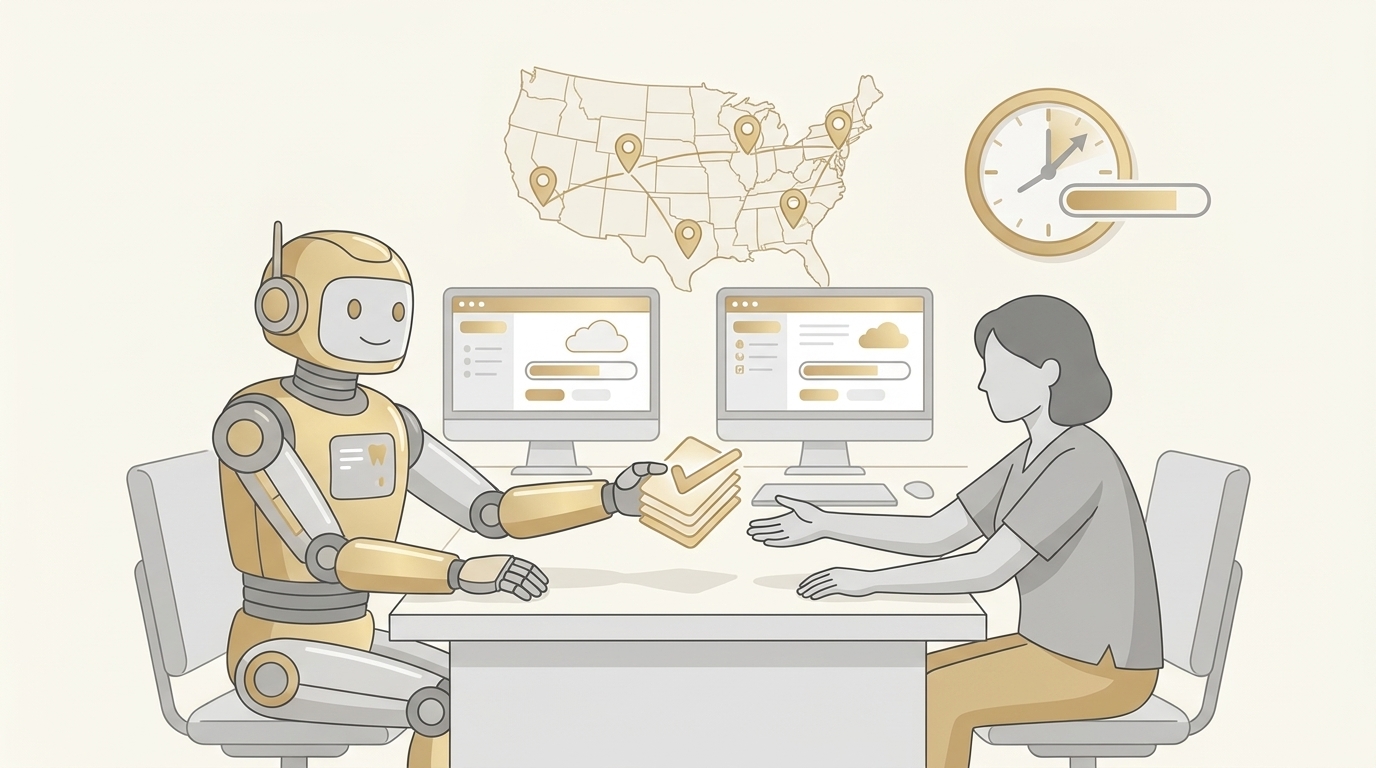
Secondary insurance automation is the use of AI agents to identify, file, track, and collect on secondary dental insurance claims across a multi-location dental organization — without requiring manual intervention at each step. This includes automated coordination of benefits (COB) verification, secondary claim generation after primary EOB adjudication, payment posting, and denial follow-up for dual-coverage patients.
For DSOs operating at scale, secondary claim automation addresses one of the most persistent sources of revenue leakage: the claims that never get filed, get filed late, or sit in limbo because no one has bandwidth to work them. According to the American Dental Association, approximately 30% of dental patients carry some form of dual coverage, yet industry estimates suggest that up to 40% of eligible secondary claims are either never submitted or written off prematurely at large dental groups.
The financial impact is staggering. A 75-location DSO generating an average of 200 claims per location per month with 30% dual coverage is looking at roughly 4,500 secondary claims monthly. At an average secondary payment of $120 per claim, that's $540,000 in monthly revenue — over $6.4 million annually — that depends entirely on whether those claims get worked. When even 20% fall through the cracks, the DSO is leaving $1.28 million on the table every year.
Ventus AI is purpose-built for exactly this kind of high-volume, high-complexity RCM challenge. Smilist, a DSO scaling to 100+ locations, deployed Ventus AI agents to standardize claim statusing across their portfolio, with AI agents now executing over 3,000 status checks per day — the kind of throughput that would require 5–8 full-time coordinators to replicate manually.
This article covers the root causes of secondary claim leakage at enterprise DSOs, a head-to-head comparison of solution models, a phased implementation roadmap, ROI benchmarks, and answers to the most common questions DSO executives ask about automating dual-coverage billing.
The Hidden Cost of Unworked Secondary Claims Across a Growing DSO
Secondary insurance has always been the ugly stepchild of dental billing. It's complex, payer rules vary wildly, and the reimbursement per claim doesn't feel large enough to justify dedicated resources — until you multiply it across an enterprise portfolio. Here's why the problem compounds at scale:
Fragmented Workflows After M&A
Most DSOs grow through acquisition. Each acquired practice brings its own billing habits, software configurations, and (often informal) secondary claim processes. Some locations file secondaries diligently. Others write them off after 30 days. Post-acquisition standardization of secondary billing workflows can take 6–12 months, and during that period, revenue leaks at every location that lacks a consistent process.
Staffing Constraints and Turnover
Dental billers are in short supply nationwide. The Bureau of Labor Statistics projects continued demand growth for billing specialists, yet turnover in dental RCM roles exceeds 30% annually at many DSOs. Secondary claims are the first thing that gets deprioritized when teams are short-staffed — they're harder, slower, and less satisfying than primary claim follow-up. The result: a growing backlog of secondary AR that no one owns.
Coordination of Benefits Complexity
Dual-coverage patients require COB determination before secondary filing — identifying which payer is primary, verifying the secondary plan's benefits and frequency limitations, and ensuring the primary EOB data is correctly attached. When this process is manual, errors cascade: claims are filed to the wrong payer, COB information is outdated, or secondary claims are denied because primary adjudication wasn't attached. Each error triggers a denial, a rework cycle, and additional FTE time.
The Valuation Impact
DSOs preparing for recapitalization or exit need to demonstrate clean AR and high net collection rates. A bloated secondary AR aging report signals operational dysfunction to potential buyers or investors. Every dollar of unworked secondary claims compresses EBITDA and, at typical DSO valuation multiples of 12–18x, directly reduces enterprise value.
For organizations that need to understand the fundamentals of dental claim denial management before tackling secondary claims, that context is critical — secondary denials follow the same payer logic, but with an added layer of COB complexity.
DSOs with 50+ locations save 40% on RCM costs in the first 90 days.
Request an Enterprise AssessmentThree Models for Secondary Claim Management: A Head-to-Head Comparison
DSO executives evaluating how to solve secondary insurance leakage at scale generally face three options. Here's how they compare:
1. In-House Manual Processing
Best for: DSOs with low dual-coverage volume and fully staffed, tenured billing teams.
- Pros: Direct control over quality; institutional knowledge of payer quirks; no vendor dependency
- Cons: Doesn't scale with acquisition growth; 30%+ annual turnover constantly resets training investment; secondary claims are always deprioritized during staffing shortages; cost-per-claim rises as volume increases
2. Outsourced Billing Partners
Best for: DSOs that want to offload secondary billing entirely and accept longer feedback loops.
- Pros: Variable cost model; shifts staffing burden to vendor; can handle volume surges
- Cons: Less visibility into day-to-day claim status; communication lag on denials and exceptions; margin compression at scale (outsourcers typically charge 5–8% of collections); limited ability to customize workflows per payer or location
3. AI Agent Automation (Ventus AI)
Best for: Enterprise DSOs (50–500+ locations) seeking standardized, scalable secondary claim processing with full visibility and control.
- Pros: Processes thousands of claims daily without FTE constraints; standardizes COB verification, claim filing, and follow-up across all locations; deploys in under 7 days; communicates via Slack, Teams, or email; handles MFA, CAPTCHAs, and payer portal security flows; maintains full audit trails for compliance
- Cons: Requires initial workflow mapping and payer-specific configuration; exceptions still need human review (though AI agents can escalate via phone or messaging)
| Capability | Manual In-House | Outsourced Billing | Ventus AI Agents |
|---|---|---|---|
| Secondary claims processed per FTE/day | 40–60 | 50–80 | 1,000+ |
| COB verification accuracy | 85–90% | 88–92% | 97%+ |
| Deployment time for new locations | 2–4 weeks | 4–8 weeks | Under 7 days |
| Visibility into claim-level status | Moderate | Low | Real-time dashboards |
| Cost model | Fixed FTE salary + benefits | 5–8% of collections | Flat per-agent pricing |
| HIPAA/SOC 2 compliance | Varies by org | Varies by vendor | SOC 2 Type II, HIPAA, BAA-ready |
| Scalability during M&A integration | Low | Moderate | High — no hiring needed |
The comparison makes clear why enterprise DSOs are increasingly moving toward AI-driven automation. The economics simply don't support scaling manual or outsourced secondary billing when you're acquiring 10–20 new locations per year. You can explore dental RCM automation capabilities in more detail to understand how agents handle each step of the secondary claim lifecycle.
Enterprise Implementation Roadmap: From Pilot Site to Full Portfolio Deployment
Rolling out secondary insurance automation across a multi-location DSO requires a structured approach. Here's a proven phased roadmap that minimizes risk and accelerates time-to-value:
Phase 1: Pilot (Weeks 1–2)
- Select 3–5 representative locations with varying payer mixes, practice management systems, and secondary claim volumes
- Map current secondary billing workflows — document where COB verification happens, who files secondaries, and how denials are tracked
- Configure AI agents for top 5–10 payers by secondary claim volume (these typically represent 70–80% of total secondary revenue)
- Establish communication channels — Ventus AI agents report via Slack, Teams, or email, so your billing leads get real-time updates without logging into another portal
- Go live in under 7 days — Ventus's browser-native automation requires no API integrations with your PMS or clearinghouse
Phase 2: Validation and Optimization (Weeks 3–6)
- Monitor agent performance daily against manual benchmarks: claims filed, COB verifications completed, denials flagged
- Refine payer-specific rules — secondary billing nuances vary by carrier (Delta Dental's COB rules differ from MetLife's, which differ from Cigna's)
- Validate payment posting accuracy against EOBs
- Quantify pilot ROI — compare secondary collections, denial rates, and cost-per-claim vs. prior period
Phase 3: Portfolio Rollout (Weeks 7–12)
- Deploy in cohorts of 10–20 locations per week
- Standardize workflows — one of the biggest wins is eliminating location-by-location variation in secondary billing practices
- Integrate escalation paths — AI agents can make phone calls to payers to resolve COB disputes or missing EOBs, then route complex exceptions to human reviewers
- Train billing leads on dashboard monitoring — shift their role from doing the work to auditing the work
Common Pitfalls to Avoid
- Skipping the workflow audit: If you don't understand how secondaries are handled today (including the locations that aren't handling them at all), you can't measure improvement
- Deploying to all locations simultaneously: Phased rollouts catch payer-specific issues early before they multiply across the portfolio
- Ignoring the change management: Billing staff need to understand that AI agents are handling the volume work so they can focus on complex cases and patient communications
Smilist's experience illustrates what a well-executed deployment looks like at enterprise scale:
"Ventus stands out from the noise in the AI and automation market. Their approach allows them to ramp up quickly in the messy middle of RCM."
— Philip Toh, Co-founder & President, Smilist
Smilist, scaling to 100+ locations, needed to standardize RCM operations across their entire portfolio — including the notoriously inconsistent secondary billing workflows that varied by location. With Ventus AI agents executing over 3,000 claim status checks daily, they eliminated the bottleneck that secondary claims created for their billing coordinators and brought consistency to a process that previously depended on individual staff tenure and training. You can see more customer stories demonstrating similar enterprise-scale results.
ROI Reality Check: What DSO CFOs Actually Achieve With Secondary Automation
The ROI on secondary insurance automation is one of the most straightforward calculations in dental RCM, because the baseline is often close to zero — many DSOs aren't effectively working secondary claims at all. Here's what the numbers look like:
Revenue Recovery
- Net-new secondary collections: DSOs typically recover $15–$25 per patient visit in secondary insurance payments that were previously unworked. Across a 100-location portfolio averaging 800 patient visits per location per month, that's $1.2M–$2.0M in annual revenue recovery.
- Denial overturn rate: AI agents catch COB errors and missing EOB attachments before submission, reducing secondary claim denial rates by 30–45% compared to manual filing.
- AR days reduction: Secondary AR aging drops from 60–90+ days to under 30 days when claims are filed immediately after primary adjudication and followed up automatically.
Cost Reduction
- FTE reallocation: Each AI agent replaces the secondary billing output of 3–5 full-time coordinators. At a fully loaded cost of $45,000–$55,000 per coordinator, a 75-location DSO can reallocate $225,000–$440,000 in annual labor costs.
- Cost-per-claim reduction: Manual secondary claim processing costs $8–$12 per claim when you factor in labor, rework, and write-offs. AI-driven processing typically drops this to $2–$4 per claim.
Timeline to Results
- Quick wins (Weeks 1–2): Pilot locations see immediate throughput — AI agents begin processing secondary claims on day one, surfacing previously unworked claims from the existing AR backlog.
- Measurable ROI (Month 2): Portfolio-wide secondary collections increase becomes visible in monthly reporting.
- Full steady-state (Month 3–4): All locations standardized, denial rates stabilized, and secondary AR aging normalized. Use the ROI calculator to model these projections against your specific portfolio metrics.
Metrics for Your Executive Dashboard
- Secondary claim submission rate: Percentage of eligible secondary claims actually filed (target: 95%+)
- Secondary collection rate: Dollars collected vs. dollars estimated owed by secondary payers
- Secondary denial rate: Percentage of secondary claims denied on first submission
- Cost per secondary claim: Total cost (labor + technology) divided by claims processed
- Secondary AR days outstanding: Average time from primary EOB receipt to secondary payment posting
For DSOs also looking to optimize primary claim operations, automated insurance verification and bulk claim status checking offer complementary wins that multiply the impact of secondary automation.
See why scaling DSOs trust Ventus AI to automate claim statusing, denials, and AR follow-up.
Request a Demo and Free RCM AuditFrequently Asked Questions
How does secondary insurance automation actually work for dental claims?
AI agents monitor primary claim adjudication, then automatically verify secondary coverage, attach the primary EOB, generate the secondary claim, and submit it to the appropriate payer — all through browser-native automation on payer portals. No API integrations with your PMS are required. Agents handle MFA, CAPTCHAs, and payer-specific security flows. When exceptions arise (e.g., COB disputes or missing information), agents can make phone calls to payers or escalate to your billing team via Slack, Teams, or email.
How much does DSO secondary insurance automation cost?
Pricing varies by volume and scope, but the ROI framework is straightforward: if your 75-location DSO is leaving $1M+ annually in unworked secondary claims, and the automation costs a fraction of the FTEs it replaces, the payback period is typically measured in weeks, not months. Most DSO CFOs see positive ROI within 60 days of deployment. Book a 30-minute demo to get a projection based on your actual claim volume and payer mix.
How long does it take to implement secondary claim automation across 50+ locations?
Under 7 days for an initial pilot at 3–5 locations. Full portfolio rollout across 50–100+ locations typically completes within 8–12 weeks using a phased cohort model. Smilist deployed Ventus AI and ramped to 3,000+ daily claim status checks across their growing portfolio — the kind of speed that traditional outsourcing or hiring simply can't match during active M&A integration.
Is secondary insurance automation HIPAA compliant and secure?
Yes. Ventus AI is SOC 2 Type II certified and fully HIPAA compliant, with executed BAAs, end-to-end encryption, role-based access controls, SSO compatibility, and complete audit trails for every claim action. Review the enterprise security details for full documentation. This is a critical differentiator from consumer AI tools like ChatGPT, which lack the compliance infrastructure required for handling PHI at scale.
What results can we expect from automating secondary dental claims?
Enterprise DSOs typically see secondary claim submission rates increase from 60–70% to 95%+, secondary collections grow by $15–$25 per patient visit, denial rates drop by 30–45%, and secondary AR aging decrease from 60–90 days to under 30 days. Exact results depend on your current baseline — DSOs with the weakest existing secondary processes see the largest gains.
Can AI agents handle coordination of benefits (COB) disputes with payers?
Yes. Ventus AI agents can make outbound phone calls to payers to resolve COB issues, verify primary/secondary payer order, and obtain missing EOB information. They follow scripted escalation paths and document every interaction with a full audit trail. Complex edge cases — like divorce-related COB changes or non-standard group plan rules — can be flagged and routed to senior billers for human review.
What practice management systems does secondary automation integrate with?
Ventus AI agents work via browser-native automation, meaning they interact with your PMS, clearinghouse, and payer portals the same way a human biller would — without requiring custom API integrations. This means compatibility with Dentrix Enterprise, Eaglesoft, Open Dental, Denticon, and virtually any web-based system. Check the integration options for specifics on your tech stack.
How does this differ from the automation features built into my clearinghouse?
Clearinghouse automation typically handles claim transmission and basic status updates but stops short of true secondary claim lifecycle management. It won't verify COB, generate secondary claims from primary EOBs, follow up on secondary denials, make phone calls to resolve exceptions, or standardize workflows across locations with different billing practices. AI agents fill the gap between what your clearinghouse transmits and what actually gets collected.
Your Next Move: A 90-Day Plan to Capture Every Secondary Dollar
Secondary insurance revenue is the most accessible source of untapped cash flow for growing DSOs. The claims have already been rendered, the primary insurance has already paid, and the secondary coverage exists — the only barrier is operational capacity to file, track, and collect consistently across every location in your portfolio.
Here's your 90-day action plan:
- Week 1: Audit your secondary claim submission rate across all locations. Identify the gap between eligible secondary claims and actual submissions. Most DSOs discover a 20–40% gap they didn't know existed.
- Week 2: Quantify the revenue impact. Multiply your gap percentage by average secondary payment per claim and annualize it. The number will get your CFO's attention.
- Weeks 3–4: Run a focused pilot at 3–5 locations with the highest dual-coverage patient populations. Measure daily throughput, denial rates, and dollars collected.
- Months 2–3: Roll out across the full portfolio in cohorts, standardizing workflows and payer-specific rules as you go. Shift your billing coordinators from manual secondary claim work to exception management and patient-facing communication.
The DSOs that move fastest on secondary automation gain a compounding advantage: every month of delay is another month of revenue leaking across every location in the portfolio.
→ See how it works on your payer mix — Book a 30-minute demo
Explore more dental RCM articles for additional strategies on optimizing your revenue cycle at enterprise scale.
Ready to Transform Your Dental RCM?
See how Ventus AI agents can automate your claim denial management and AR follow-up across all your locations in under 7 days—no complex integrations required.
Book Your Free Demo
Enterprise AI Automation for Healthcare RCM
Written by the Ventus AI team — healthcare RCM practitioners, automation engineers, and former revenue cycle leaders building AI agents that work as teammates alongside billing teams. Ventus is SOC 2 Type II certified and HIPAA compliant.