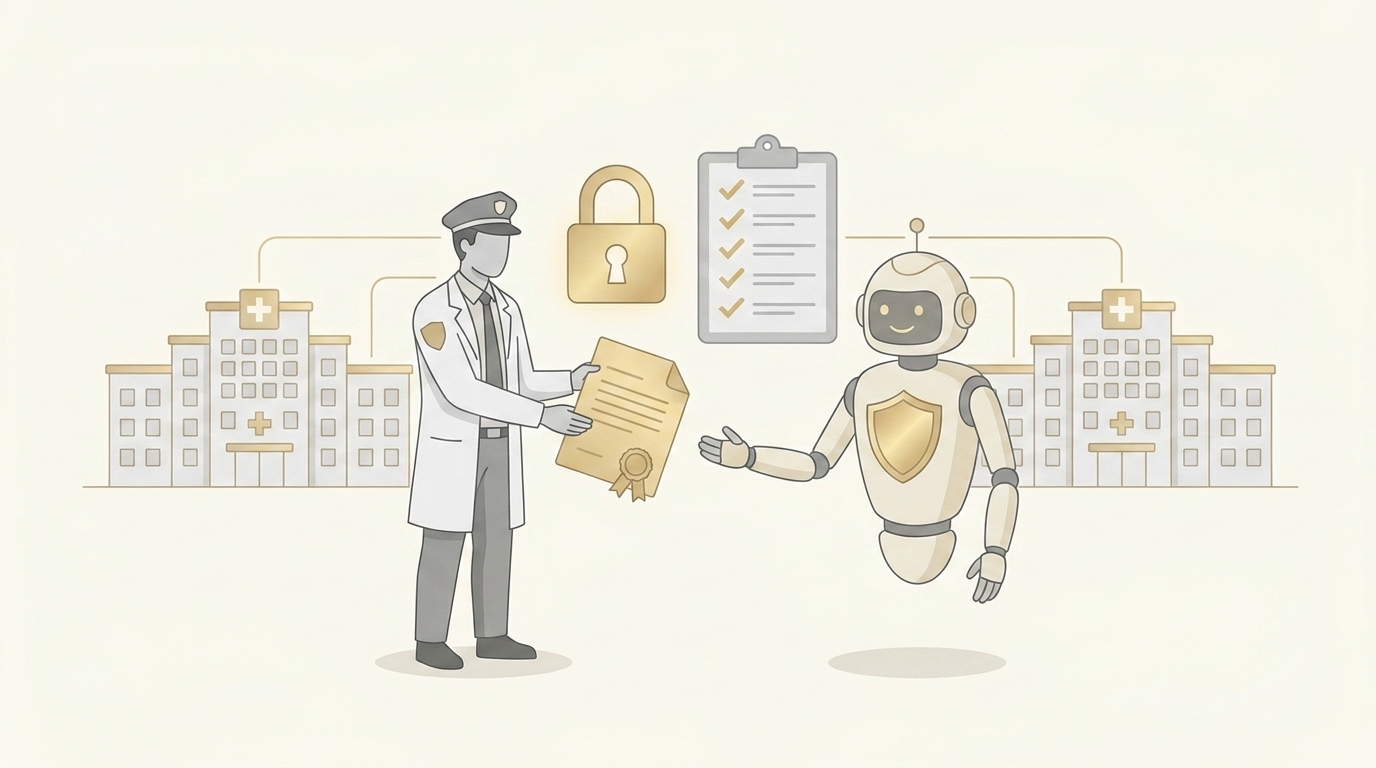


How are enterprise teams actually working alongside AI agents in 2026? Explore the human + AI operating model driving 40%+ FTE savings at scale.
The promise of AI in enterprise operations has shifted from theoretical to operational. In 2026, the organizations pulling ahead aren't the ones that adopted AI fastest — they're the ones that designed the right operating model around it. The question is no longer should we deploy AI agents, but how do we structure our teams, workflows, and governance to maximize their impact across hundreds of locations and millions of transactions?
This guide breaks down the human + AI agent operating model that leading healthcare systems, DSOs, and RCM companies are using right now — with real case studies, comparison frameworks, and a 90-day action plan your executive team can implement immediately.
What Is the Human + AI Agent Operating Model?
The human + AI agent operating model is an enterprise workforce design pattern where autonomous AI agents handle high-volume, rules-based operational tasks — such as claim status checking, insurance verification, invoice processing, and data entry — while human team members focus on complex exceptions, relationship management, strategic decisions, and quality oversight. Unlike traditional automation (macros, RPA bots), AI agents can navigate dynamic interfaces, handle multi-factor authentication, interpret unstructured data, and escalate intelligently when they encounter edge cases.
At enterprise scale, this model delivers transformative results. Ventus AI agents, for example, enable organizations to execute thousands of repetitive tasks daily with sub-7-day deployment timelines and zero API integrations. Smilist, a DSO scaling to 100+ locations, deployed Ventus AI agents to execute over 3,000 claim status checks daily — work that would otherwise require 5–8 full-time coordinators. That's the operating model in action: AI agents as tireless digital teammates, with human experts directing strategy and handling the 5–10% of cases that require judgment.
This article covers the enterprise challenges driving adoption, the three dominant operating models organizations are choosing between, a step-by-step implementation roadmap, measurable ROI benchmarks, and a detailed FAQ section for procurement and compliance teams evaluating AI agent vendors.
The Hidden Cost of Running Enterprise Operations Without an AI Operating Model
Enterprise healthcare and logistics organizations in 2026 face a compounding problem: transaction volumes are growing faster than their ability to hire, train, and retain the staff needed to process them. Consider the math facing a health system VP of Revenue Cycle managing 150,000+ claims per month, or a DSO CFO integrating 15 newly acquired practices into a standardized billing workflow.
The staffing crisis is structural, not cyclical
The Bureau of Labor Statistics projects healthcare administrative support roles will face a 12–15% shortfall through 2030. For enterprise organizations, this manifests as:
- Chronic understaffing: Open positions for billing coordinators, AR follow-up specialists, and verification staff sit unfilled for 60–90 days on average.
- Training cost compounding: Each new hire requires 4–8 weeks of training on payer-specific workflows. At a 30–40% annual turnover rate common in billing operations, organizations are perpetually in training mode.
- Quality degradation at scale: When experienced staff leave, institutional knowledge about payer quirks, denial patterns, and appeal strategies walks out the door.
The financial impact is staggering. A 200-location DSO with an average 8% denial rate and $450 average claim value is leaving $5M–$8M annually in recoverable revenue on the table — not because claims are unwinnable, but because there aren't enough human hours to work them. Health systems report similar dynamics: McKinsey estimates that 25–30% of all healthcare administrative spending — roughly $250 billion annually in the U.S. — is wasted on manual processes that could be automated.
Meanwhile, consumer AI tools like ChatGPT and browser automation products have created boardroom enthusiasm but operational anxiety. CIOs and compliance officers rightly ask: Can these tools handle PHI? Do they maintain audit trails that satisfy SOC 2 and HIPAA requirements? The answer, for consumer-grade tools, is almost always no.
This is the gap the human + AI agent operating model fills — not by replacing your workforce, but by giving every human team member an AI colleague that handles the volume work while they handle the judgment work.
Enterprise teams deploy in 7 days — no integration required.
Book Your Free 15-Minute DemoThree Operating Models for Enterprise AI Adoption: A Head-to-Head Comparison
When enterprise leaders evaluate how to integrate AI agents into their operations, three distinct models emerge. Each has trade-offs depending on organizational maturity, compliance requirements, and scale ambitions.
1. The "Bolt-On" Model (AI as a Tool)
Best for: Organizations in early exploration with limited IT resources and a desire to test AI on a single workflow.
- Pros: Low initial investment; can be piloted by a single department; doesn't require organizational restructuring
- Cons: Creates silos; AI tools often lack enterprise compliance (HIPAA, SOC 2); no unified governance; difficult to scale beyond pilot; no audit trails for regulated industries
2. The "Center of Excellence" Model (AI as a Managed Function)
Best for: Mid-maturity organizations with dedicated IT/operations leadership ready to standardize AI deployment across departments.
- Pros: Centralized governance and vendor management; standardized deployment playbooks; better compliance oversight; measurable ROI tracking across business units
- Cons: Requires dedicated headcount to manage the CoE; can become a bottleneck if under-resourced; 3–6 month setup before first deployments
3. The "Embedded Teammate" Model (AI Agents as Workforce Members)
Best for: Enterprise organizations at scale — DSOs with 50+ locations, health systems managing 100K+ claims/month, and RCM companies seeking margin expansion.
- Pros: AI agents are deployed directly into existing team workflows via Slack, Teams, and email; human supervisors manage AI agents like junior staff; fastest time-to-value (under 7 days with Ventus); scales linearly without hiring; maintains full audit trails and HIPAA compliance
- Cons: Requires executive sponsorship and change management; team leads need training on exception-handling workflows; works best with a vendor that provides enterprise-grade security and BAA coverage
The "Embedded Teammate" model is where enterprise healthcare and operations leaders are converging in 2026. It's the model that Ventus AI was purpose-built to enable.
Comparison: Traditional Staffing vs. Outsourced BPO vs. Ventus AI Agents
| Capability | In-House Staff | Outsourced BPO | Ventus AI Agents |
|---|---|---|---|
| Deployment time | 60–90 days (recruiting + training) | 30–60 days (onboarding + SLAs) | Under 7 days |
| Scalability | Linear cost increase per FTE | Moderate (contract renegotiation) | Near-instant — add workflows, not headcount |
| Cost per claim | $4.50–$7.00 | $3.00–$5.00 | $0.50–$1.50 |
| HIPAA / SOC 2 compliance | Varies by training | Varies by vendor | SOC 2 Type II certified, BAA-ready |
| Handles MFA & CAPTCHAs | Yes (manual) | Yes (manual) | Yes (browser-native automation) |
| Audit trail | Manual documentation | Vendor-dependent | Automatic, per-transaction logging |
| Available hours | 8–10 hrs/day | 8–16 hrs/day (shift-dependent) | 24/7/365 |
| Exception escalation | Direct (human judgment) | Delayed (queued to onshore team) | Real-time via Slack, Teams, email, or phone |
| Turnover risk | 30–40% annually | 20–30% annually | 0% |
This comparison underscores why the embedded teammate model is gaining traction: it combines the compliance rigor of in-house operations with the scalability and cost structure that BPOs promise but rarely deliver consistently.
Enterprise Implementation Roadmap: From Pilot Workflow to Full Organizational Deployment
The most successful enterprise AI deployments follow a structured four-phase approach. Here's the roadmap that Ventus AI recommends and supports for organizations deploying AI agents across healthcare and operations workflows.
Phase 1: Executive Alignment & Workflow Selection (Week 1)
- Identify the highest-ROI workflow: Start with the task that consumes the most FTE hours with the most predictable logic. For healthcare organizations, this is almost always claim status checking, insurance verification, or eligibility verification.
- Secure executive sponsorship: The VP of Revenue Cycle, CIO, or COO must own the initiative. Without C-suite backing, pilots stall in IT security review.
- Define success metrics upfront: Claims processed per day, cost per claim, error rate, and time-to-resolution are the four KPIs that matter most.
Phase 2: Focused Pilot Deployment (Weeks 1–2)
Ventus AI agents deploy via browser-native automation — no API integrations, no EHR vendor negotiations, no 6-month IT projects. A typical pilot covers a single workflow (e.g., batch claim status checks across 3–5 payer portals) at a single site or business unit.
"Ventus stands out from the noise in the AI and automation market. Their approach allows them to ramp up quickly in the messy middle of RCM."
— Philip Toh, Co-founder & President, Smilist
Smilist's pilot went from kickoff to 3,000+ daily claim status checks in a matter of days — a volume that would have required hiring and training 5–8 full-time coordinators.
Phase 3: Validation & Expansion (Weeks 3–6)
- Audit results against baseline: Compare AI agent throughput, accuracy, and cost against the manual process it replaced. Use the ROI calculator to quantify savings.
- Train human supervisors: Team leads learn to review AI agent exception queues, approve escalations, and refine agent logic for payer-specific edge cases.
- Expand to adjacent workflows: Once claim statusing is validated, add denial management, AR follow-up, or prior authorization.
Phase 4: Enterprise-Wide Rollout (Months 2–3)
- Standardize across locations: Deploy the validated workflow template across all sites, business units, or client accounts.
- Integrate into existing communication infrastructure: Ventus AI agents report via Slack, Teams, or email — they slot into your existing operational cadence.
- Establish ongoing governance: Monthly QBRs with your AI vendor, quarterly ROI reviews with the CFO, and continuous workflow optimization.
Common Pitfalls to Avoid
- Starting too broad: Don't try to automate 10 workflows simultaneously. Start with one, prove ROI, then expand.
- Skipping compliance review: Ensure your vendor provides a signed BAA, SOC 2 Type II certification, and role-based access controls before any PHI touches the system. Review Ventus AI's enterprise security documentation early in the process.
- Neglecting change management: AI agents work best when human team members understand their role in the new operating model. Invest in training and communication.
- Choosing tools that require API access: Many healthcare IT environments restrict API access. Browser-native automation (Ventus's approach) bypasses this entirely.
ROI Reality Check: What Enterprise Healthcare and Operations Leaders Actually Achieve
Enterprise AI agent deployments deliver measurable ROI across four dimensions. Here's what organizations are reporting in 2026.
Financial Impact
- FTE cost avoidance: Organizations deploying AI agents for claim statusing, verification, and AR follow-up report 40–60% reduction in FTE hours dedicated to these tasks. At a fully loaded cost of $55,000–$70,000 per billing coordinator, a 100-location DSO can avoid $500K–$1.2M in annual labor costs.
- Revenue recovery acceleration: Faster claim follow-up reduces days in AR. Organizations report 15–25% improvement in collections velocity within 90 days.
- Cost-per-claim reduction: From $4.50–$7.00 (manual) to $0.50–$1.50 (AI agent-assisted), representing a 70–85% reduction.
Operational Impact
- Throughput multiplication: Smilist's 3,000+ daily status checks represent a 10–15x throughput increase over the manual equivalent — without adding a single FTE.
- Error rate reduction: AI agents follow payer-specific logic consistently, eliminating the transcription errors and missed follow-ups that plague manual workflows.
- 24/7 availability: AI agents process claims overnight and on weekends, ensuring Monday morning AR queues are already worked.
Timeline to Results
- Quick wins (Week 1–2): Single-workflow pilot processing 500–3,000+ claims/day
- Validated ROI (Month 1–2): Measurable cost-per-claim reduction and FTE hour reallocation
- Enterprise-scale impact (Month 3–6): Multi-workflow, multi-location deployment with portfolio-wide KPI improvement
Key Metrics for Executive Dashboards
- Claims processed per AI agent per day: benchmark against FTE equivalent
- Cost per claim (blended): total AI + human cost divided by claims processed
- Exception rate: percentage of tasks requiring human intervention (target: under 10%)
- Days in AR (before vs. after): the clearest revenue cycle impact metric
For a personalized projection, explore the Ventus AI ROI calculator with your organization's specific volume and payer mix data.
See how enterprise healthcare organizations deploy AI agents in under 7 days.
Request a DemoFrequently Asked Questions
How does the human + AI agent operating model actually work day-to-day?
AI agents handle high-volume, repetitive tasks autonomously — logging into payer portals, checking claim statuses, verifying eligibility, and updating your systems — while human team members manage exceptions, appeals, and strategic decisions. Ventus AI agents communicate via Slack, Teams, and email, so your team receives real-time updates and escalation alerts within their existing workflows. Think of it as having a team of digital coordinators who never call in sick, work 24/7, and escalate anything unusual to your experienced staff for review.
How much does deploying AI agents cost compared to hiring staff?
AI agent deployments typically reduce cost-per-claim from $4.50–$7.00 (fully loaded FTE) to $0.50–$1.50, representing a 70–85% reduction. The ROI framing matters more than the sticker price: a 100-location organization avoiding 5–8 FTEs of manual claim statusing saves $350K–$560K annually in labor alone, before accounting for faster collections and reduced denial write-offs. Use the Ventus AI ROI calculator to model your specific economics.
How long does it take to deploy AI agents across an enterprise organization?
Under 7 days for a focused pilot with Ventus AI. Because Ventus agents use browser-native automation rather than API integrations, there's no dependency on your EHR vendor, IT backlog, or integration timeline. Smilist went from kickoff to 3,000+ daily claim status checks within days. A typical enterprise-wide rollout — from pilot to multi-location deployment — takes 60–90 days, with measurable ROI visible within the first 2–4 weeks.
Is this approach HIPAA compliant and SOC 2 certified?
Yes. Ventus AI is SOC 2 Type II certified and fully HIPAA compliant, with signed Business Associate Agreements (BAAs) available for all healthcare clients. Every transaction generates a complete audit trail with timestamps, actions taken, and outcomes recorded. The platform supports role-based access controls and is SSO-compatible. Review the full security and compliance documentation for details that your IT security and procurement teams will need during vendor evaluation.
What results can enterprise organizations realistically expect?
Enterprise organizations deploying AI agents for RCM workflows report 40–60% FTE hour reduction on targeted tasks, 15–25% improvement in collections velocity, and 70–85% cost-per-claim reduction. Smilist executes 3,000+ claim status checks daily — replacing the output of 5–8 full-time coordinators. These results are achievable within 90 days for organizations that follow the phased implementation approach outlined in this guide. View additional customer stories for industry-specific benchmarks.
Can AI agents handle multi-factor authentication and complex payer portals?
Yes. Ventus AI agents operate via browser-native automation and are specifically designed to navigate MFA flows, CAPTCHAs, session timeouts, and the inconsistent interfaces common across payer portals. This is a critical differentiator from consumer AI tools (like ChatGPT or browser-based automation plugins) that break when they encounter security challenges. Ventus agents also make phone calls to payers when portal-based resolution isn't possible — handling the full spectrum of claim resolution, not just the easy cases.
How does this differ from traditional RPA (robotic process automation)?
Traditional RPA tools follow rigid, pre-scripted workflows that break when a portal changes its layout, adds a new login step, or introduces an unexpected prompt. AI agents are adaptive — they can interpret dynamic interfaces, make contextual decisions, and handle exceptions intelligently. This is the difference between a macro that clicks the same buttons in the same order and a digital teammate that understands what it's trying to accomplish. For a deeper technical comparison, read RPA vs. AI agents: the real difference.
What if our organization has unique payer rules or custom workflows?
Ventus AI agents are configured to your specific payer mix, workflow logic, and escalation preferences during the pilot phase. They adapt to payer-specific quirks — different portal layouts, unique denial codes, state-specific Medicaid rules — without requiring custom code or API development. As your organization grows (through M&A, new payer contracts, or geographic expansion), agents scale with you. The platform also supports white-label deployment for RCM companies managing multiple client accounts. Explore integration options for your technology stack.
Your Next Move: A 90-Day Action Plan for Enterprise AI Agent Adoption
The human + AI agent operating model isn't a future-state vision — it's the operating standard for enterprise healthcare and operations organizations in 2026. Here's how to move from evaluation to execution in 90 days.
- Days 1–7 — Executive alignment: Identify your highest-volume, most repetitive workflow (claim statusing, verification, AR follow-up). Assign an executive sponsor. Define three success metrics.
- Days 8–21 — Pilot deployment: Deploy Ventus AI agents on a single workflow at a single site. Measure throughput, cost per claim, and exception rate against your manual baseline.
- Days 22–45 — Validate and expand: Review pilot results with your CFO and operations leadership. Add a second workflow or expand the first to additional locations.
- Days 46–90 — Enterprise rollout: Standardize across all locations or client accounts. Establish governance cadence (monthly reviews, quarterly ROI reports). Reallocate freed FTE hours to high-judgment work: denial appeals, patient communication, and strategic payer negotiations.
The organizations that will dominate their markets over the next 3–5 years are the ones building the human + AI operating model now — not waiting for the technology to get "more mature." The technology is mature. The question is whether your operating model is ready to leverage it.
→ See how Ventus AI agents work on your payer mix — Book a 30-minute demo
Ready to Transform Your Revenue cycle?
See how Ventus AI agents can automate your end-to-end RCM automation with AI agents in under 7 days—no complex integrations required.
Book Your Free Demo
Enterprise AI Automation for Healthcare RCM
Written by the Ventus AI team — healthcare RCM practitioners, automation engineers, and former revenue cycle leaders building AI agents that work as teammates alongside billing teams. Ventus is SOC 2 Type II certified and HIPAA compliant.