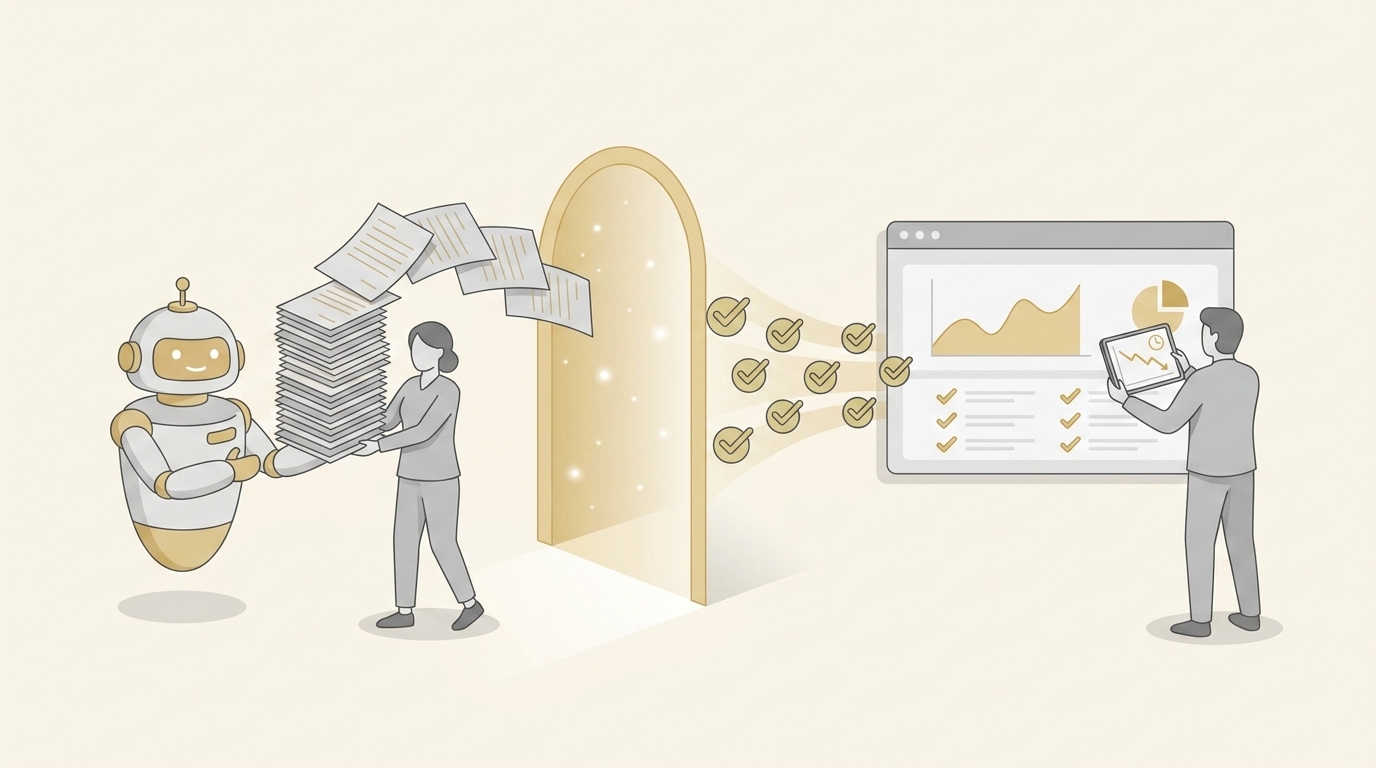



How do health systems recover denied revenue without adding staff? Automated claim appeals recover $2M+ annually with AI agents. See the 2026 playbook.
What is Automated Claim Appeal Processing?
Automated claim appeal processing uses AI agents to identify denied claims, generate compliant appeal letters, submit documentation to payers, and track outcomes—without requiring manual intervention from your revenue cycle staff. For health systems managing 100K+ claims per month, this means recovering millions in previously written-off revenue while reducing appeal cycle times from 45–90 days to under 14 days.
The scale of the denial problem in 2026 is staggering. According to the American Hospital Association, hospitals spent $19.7 billion on denial-related administrative costs in a single year, and the average health system writes off 1–3% of net patient revenue due to unworked denials. For a $500M health system, that's $5–15M in annual revenue leakage.
Ventus AI deploys browser-native AI agents that log into payer portals, pull denial reason codes, cross-reference clinical documentation, generate appeal narratives, and submit appeals—all within existing workflows. In the healthcare vertical, organizations like Smilist have already demonstrated what enterprise-scale AI agents deliver: 3,000+ claim status checks daily, replacing work that would require 5–8 full-time coordinators. The same architecture powers medical RCM automation for health systems tackling denials at scale.
This guide covers the hidden costs of manual appeal processes, three models for denial recovery, an enterprise implementation roadmap, realistic ROI projections, and a 90-day action plan for VP Revenue Cycle and CFO-level leaders ready to stop hemorrhaging revenue.
The $15M Problem: Why Manual Appeals Fail at Enterprise Scale
Denial rates have climbed steadily since 2020. MGMA reports that the average initial denial rate now sits between 10–15% for commercial claims, with some payers exceeding 20% for prior authorization-related denials. For a health system processing 150,000 claims monthly, that's 15,000–22,500 denials requiring attention every single month.
Here's where it breaks down at scale:
Volume Overwhelms Staff Capacity
A skilled appeals coordinator handles 25–40 appeals per day, depending on complexity. At 15,000 monthly denials with a 60% appeal-worthy rate, you need 9,000 appeals filed monthly—requiring 15–20 dedicated FTEs just for appeals. Most health systems allocate 5–8, leaving 40–60% of appealable denials unworked.
M&A Integration Compounds the Problem
After acquiring a physician group or community hospital, denial patterns shift dramatically. New payer contracts, different credentialing timelines, and inconsistent coding practices across acquired entities create denial spikes of 25–40% during integration periods. One mid-Atlantic health system reported a 34% denial rate in the first 90 days after absorbing a 12-provider cardiology practice.
The Real Cost Isn't Just Lost Revenue
Beyond the write-offs, consider the compounding impact:
- FTE cost per appeal: $18–35 fully loaded (including management oversight, QA, and rework)
- Timely filing risk: 12–18% of unworked appeals miss payer deadlines entirely
- Cash flow delay: Average appeal resolution takes 60–90 days, creating working capital pressure
- Staff burnout: Appeals teams experience 35–45% annual turnover, creating perpetual training cycles
The math is clear: health systems either hire aggressively into a labor market with 15% RCM vacancy rates, or they find a way to automate the repetitive mechanics of appeal generation and submission. You can estimate your organization's specific savings using our ROI calculator.
Health systems using AI agents cut claim denial rates by 30% in 90 days.
Request an Enterprise AssessmentThree Models for Automated Claim Appeals: A Head-to-Head Comparison
Health system leaders evaluating denial recovery automation typically consider three approaches. Each has distinct tradeoffs depending on your organization's scale, payer complexity, and internal capabilities.
1. In-House Rules Engine
Best for: Health systems with strong IT teams and relatively simple payer mixes (5–10 primary payers covering 80%+ of volume).
- Pros: Full control over logic and customization; no per-claim fees; integrates with existing EHR workflows
- Cons: 6–12 month build time; requires dedicated developers and ongoing maintenance; breaks when payer portals update; limited to template-based appeals without clinical nuance
2. Outsourced Appeal Services
Best for: Organizations needing immediate capacity relief without technology investment.
- Pros: Fast ramp-up (2–4 weeks); no technology risk; predictable per-appeal pricing
- Cons: $35–75 per appeal (eroding ROI on lower-dollar claims); limited transparency into process; vendor lock-in; no institutional knowledge building; margin compression at scale
3. AI Agent Automation (Ventus Approach)
Best for: Health systems, large medical groups, and RCM companies managing 100K+ claims/month who need scale without headcount growth.
- Pros: Deploys in under 7 days; handles any payer portal via browser-native automation; generates clinical appeal narratives; learns denial patterns; costs fraction of FTE or outsourced model; maintains audit trails
- Cons: Requires initial workflow mapping; best results when paired with human exception handling for complex medical necessity disputes
Comparison: Appeal Processing Approaches
| Capability | Manual (In-House Staff) | Outsourced Vendor | Ventus AI Agents |
|---|---|---|---|
| Appeals processed per day | 25–40 per FTE | 50–100 per coordinator | 500–2,000+ per agent |
| Cost per appeal | $18–35 | $35–75 | $3–8 |
| Deployment timeline | Immediate (if staff available) | 2–4 weeks | Under 7 days |
| Payer portal coverage | Limited by staff bandwidth | Depends on vendor | Any browser-accessible portal |
| Appeal quality consistency | Variable (staff-dependent) | Moderate | High (template + AI-generated clinical narrative) |
| Timely filing compliance | 82–88% | 90–95% | 99%+ |
| Audit trail & reporting | Manual tracking | Vendor-dependent | Automated, real-time dashboards |
| HIPAA/SOC 2 compliance | N/A (internal) | Varies | SOC 2 Type II, BAA-ready |
| Scalability during denial spikes | Hire/train (8–12 weeks) | Request more capacity | Instant |
For organizations evaluating enterprise security requirements, Ventus AI agents operate with role-based access controls, encrypted data handling, and complete audit trails for every appeal action taken.
Enterprise Implementation Roadmap: From Pilot Payer to Full-Scale Recovery
Deploying automated claim appeals across a health system requires a phased approach that builds confidence, demonstrates ROI, and scales without disrupting existing operations.
Phase 1: Denial Pattern Analysis (Days 1–3)
Ventus AI agents connect to your clearinghouse or payer portals and pull 90 days of denial data. The system categorizes denials by:
- Denial reason code (CO-4, CO-16, CO-197, PR-204, etc.)
- Payer and plan type (commercial, Medicare Advantage, Medicaid managed care)
- Service line and CPT family (identify which departments generate highest-value appealable denials)
- Dollar impact (prioritize appeals by recovery potential)
Phase 2: Pilot Launch — Single Payer, High-Volume Denial Category (Days 4–7)
Start with your highest-volume, most predictable denial type. For most health systems, this is CO-4 (coding/modifier denials) or CO-16 (information requested) from a single major commercial payer.
Common pitfalls to avoid:
- Starting too broad: Don't launch across all payers simultaneously; one payer lets you validate appeal acceptance rates before scaling
- Skipping QA cycles: Review the first 50 AI-generated appeals before fully automating submission
- Ignoring exception workflows: Define clear escalation paths for denials requiring physician peer-to-peer review
Phase 3: Expand to All Commercial Payers (Weeks 2–4)
Once pilot payer appeal success rates stabilize at 55%+ overturn rate, expand to additional payers. Ventus agents handle MFA, CAPTCHAs, and portal-specific security flows, so adding payers doesn't require new integrations—just portal credential configuration.
Success factors for multi-facility deployment:
- Standardized denial taxonomies: Ensure all facilities map to consistent denial reason code categories
- Centralized reporting: Executive dashboards showing recovery by facility, payer, and service line
- Change management: Brief appeals teams on their new role—handling complex exceptions while AI manages routine appeals
Phase 4: Full-Scale Operations (Month 2+)
At full scale, AI agents process all initial-level appeals automatically, escalate complex cases to human specialists, and communicate status updates via Slack, Teams, or email. For denials requiring phone follow-up, Ventus agents can make outbound calls to payer representatives.
"Ventus stands out from the noise in the AI and automation market. Their approach allows them to ramp up quickly in the messy middle of RCM."
— Philip Toh, Co-founder & President, Smilist
Smilist's experience illustrates what enterprise healthcare organizations achieve: executing 3,000+ claim status checks daily—work that would require 5–8 full-time coordinators. The same agent architecture powers appeal generation, submission, and tracking for health systems at even greater scale. Learn more about how this applies to dental RCM automation across multi-location organizations.
For organizations building their appeal narratives, our claim narrative generator provides a starting framework that AI agents can customize with patient-specific clinical documentation.
ROI Reality Check: What Health System CFOs Actually Achieve with Automated Appeals
The financial case for automated appeals is straightforward when you model it against your own denial volume. Here's what enterprise healthcare organizations report:
Expected Outcomes
- Annual revenue recovery: $1.5M–$4M+ for health systems processing 100K–300K claims/month (based on 55–65% appeal overturn rates on previously unworked denials)
- FTE reallocation: 8–15 FTE equivalents redirected from routine appeals to complex case management and payer negotiations
- Cost-per-appeal reduction: From $18–35 (manual) to $3–8 (automated), representing 75–85% cost reduction
- Timely filing compliance: From 82–88% to 99%+, eliminating revenue lost to missed deadlines
- Appeal cycle time: From 60–90 days to 14–21 days average resolution
Key Metrics to Track
- Appeal submission rate: Percentage of appealable denials that actually get appealed (target: 95%+)
- Overturn rate by denial category: Track which denial types respond best to automated appeals
- Net recovery per FTE dollar: Compare total recovered revenue against total program cost (staff + technology)
- Days in AR for appealed claims: Measure cash acceleration impact
Timeline to Results
- Quick wins (Week 1–2): Pilot payer live, first appeals submitted, initial overturn data emerging
- Measurable impact (Month 1–2): $150K–$400K in recovered revenue from previously unworked denials
- Full ROI realization (Month 3–6): Program covers all payers, denial prevention insights reduce initial denial rates by 8–12%, recovered revenue exceeds $1M
These projections align with HFMA research showing that 63% of denied claims are recoverable, but only 35% of hospitals appeal the majority of their denials. The gap between "recoverable" and "recovered" is where automation delivers outsized returns. Calculate your organization's specific opportunity with our ROI calculator.
See how health systems use AI agents for prior auth, eligibility, and claims at 100K+ claims/month.
Request a Demo and Free RCM AuditFrequently Asked Questions
How does automated claim appeal processing work?
AI agents log into payer portals using browser-native automation, identify denied claims by reason code, cross-reference clinical documentation from your EHR, generate compliant appeal letters with patient-specific clinical narratives, and submit them directly to the payer—all without API integrations. The agents handle MFA, CAPTCHAs, and portal-specific workflows, then report status via Slack, Teams, or email. For claims requiring phone follow-up, agents can make outbound calls to payer representatives.
How much does automated appeal processing cost compared to manual?
Automated appeals typically cost $3–8 per appeal versus $18–35 for manual staff processing or $35–75 for outsourced vendors. For a health system filing 5,000 appeals monthly, that's a difference of $75K–$135K in monthly processing costs alone—before counting the additional revenue recovered from previously unworked denials. Most organizations achieve full ROI within 60–90 days of deployment.
How long does implementation take for a health system?
Under 7 days for initial deployment with Ventus AI agents. A focused pilot on your highest-volume payer and denial category goes live in the first week. Full-scale deployment across all commercial payers typically completes within 30 days. No API integrations, EHR modifications, or IT project queues are required—agents work through the same browser interfaces your staff uses today.
Is automated appeal processing HIPAA compliant and secure?
Yes. Ventus AI is SOC 2 Type II certified and fully HIPAA compliant with enterprise security controls including BAA execution, end-to-end encryption, role-based access controls, SSO compatibility, and comprehensive audit trails for every appeal action. Every document accessed, letter generated, and submission made is logged with timestamps and user attribution for compliance review.
What appeal overturn rates can we expect?
Health systems using automated appeals typically achieve 55–65% overturn rates on initial-level appeals, compared to 45–55% for manual processes. The improvement comes from consistency: AI agents never miss required documentation elements, always cite correct plan language, and submit within optimal timeframes. For medical claim denial management, automated systems also identify patterns that inform denial prevention strategies.
Can AI agents handle complex medical necessity appeals?
AI agents excel at generating initial-level appeals for coding, modifier, authorization, and information-request denials (CO-4, CO-16, CO-197, PR-204). For complex medical necessity disputes requiring physician peer-to-peer review, agents prepare the clinical summary, identify supporting literature, and escalate to your medical director with a complete case package. This hybrid approach ensures human expertise applies where it matters most.
What payer portals and systems are supported?
Ventus AI agents work with any browser-accessible payer portal—Availity, Navinet, Change Healthcare, individual payer sites (UHC, Aetna, Cigna, BCBS variants), and Medicare Administrative Contractors. Because agents use browser-native automation rather than APIs, adding new payers requires only portal credentials, not development work. Review our integration options for details on clearinghouse and EHR connectivity.
How does this integrate with our existing revenue cycle workflow?
Agents operate alongside your existing team and systems. They communicate via Slack, Teams, or email with configurable escalation rules. Appeals are tracked in real-time dashboards accessible to managers and executives. Most organizations keep their existing denial management software and use Ventus agents as the execution layer—filing appeals, tracking statuses, and reporting outcomes back into your existing reporting structure.
Your Next Move: 90-Day Action Plan for Automated Appeal Recovery
For health system CFOs and VP Revenue Cycle leaders ready to stop writing off recoverable revenue, here's a concrete action plan:
- Week 1 — Quantify your denial gap: Pull 90 days of denial data and calculate: (a) total appealable denials, (b) percentage currently appealed, (c) dollar value of unworked appealable denials. This number is your automation opportunity.
- Week 2 — Identify your pilot target: Select your highest-volume commercial payer and most common denial reason code. This becomes your proof-of-concept scope.
- Week 3–4 — Deploy and validate: Launch AI agents on your pilot scope. Review first 50 appeal submissions for quality. Measure submission speed, accuracy, and initial payer responses.
- Month 2 — Scale across payers: Expand to all commercial payers. Establish executive dashboards tracking recovery by facility, payer, and service line. Brief finance team on cash flow acceleration.
- Month 3 — Optimize and prevent: Use denial pattern data to implement upstream fixes (coding education, authorization process improvements, eligibility verification enhancements). Shift from recovery to prevention.
The organizations that move first capture the largest recovery opportunity—before payers adapt their denial strategies. Every month of delay represents $125K–$350K in unrecovered revenue for a typical health system.
Explore more medical RCM guides for additional strategies on eligibility verification automation and prior authorization workflows that reduce denials before they occur.
→ See how it works on your payer mix — Book a 30-minute demo
Ready to Transform Your Healthcare revenue cycle?
See how Ventus AI agents can automate your prior auth, eligibility, and claims automation at scale in under 7 days—no complex integrations required.
Book Your Free Demo
Enterprise AI Automation for Healthcare RCM
Written by the Ventus AI team — healthcare RCM practitioners, automation engineers, and former revenue cycle leaders building AI agents that work as teammates alongside billing teams. Ventus is SOC 2 Type II certified and HIPAA compliant.