
How do health systems cut first-pass rejection rates below 2%? AI claims scrubbing catches errors before submission—saving millions across 100K+ claims/month.
What Is Claims Scrubbing for Health Systems?
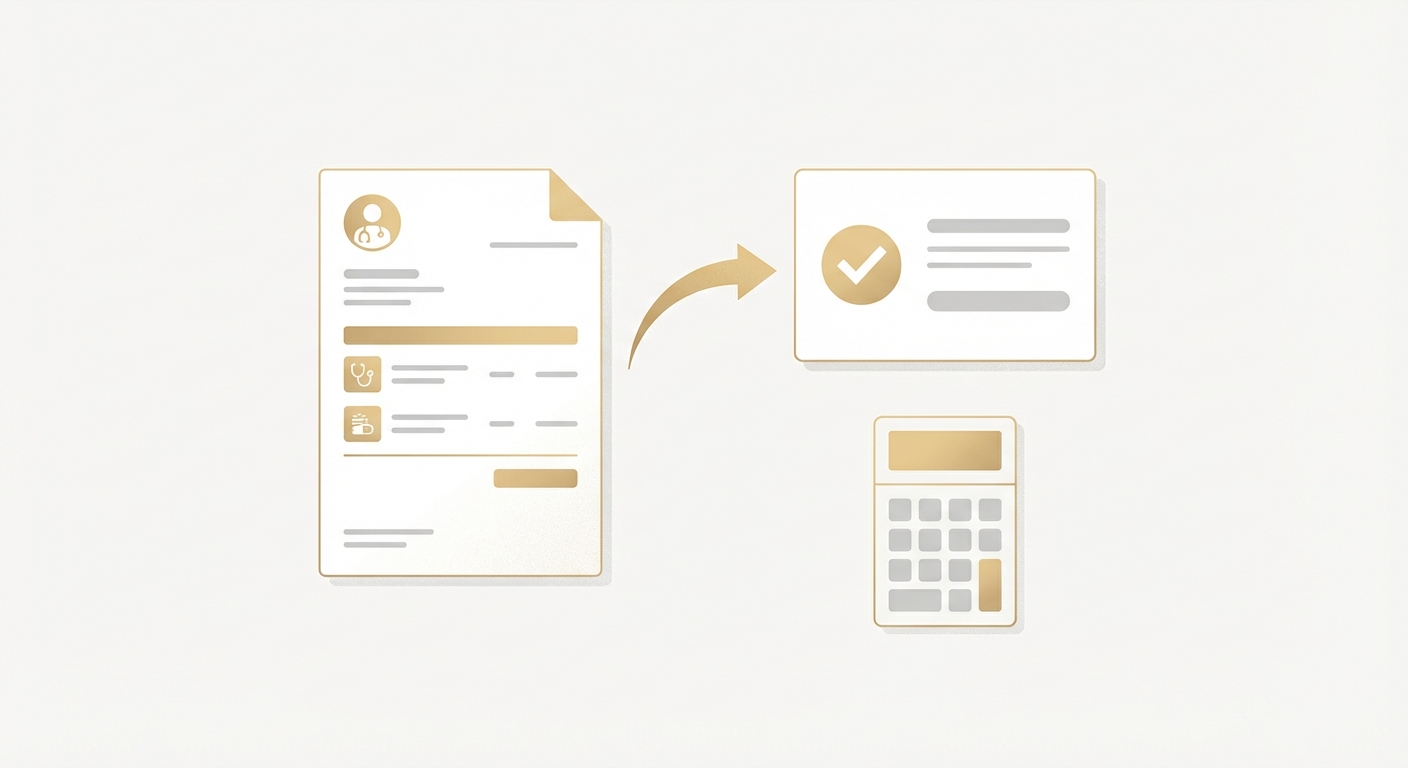
Claims scrubbing is the systematic pre-submission review of medical claims to identify and correct errors—missing modifiers, invalid diagnosis codes, mismatched CPT-ICD pairings, authorization gaps, and demographic mismatches—before they reach the payer. For health systems processing 100,000 or more claims per month, effective claims scrubbing is the single highest-leverage intervention in the revenue cycle because every percentage point improvement in first-pass acceptance translates directly into faster cash, lower cost-to-collect, and reduced FTE burden on an already stretched billing workforce.
The national average medical claim rejection rate hovers between 5% and 10%, according to MGMA and HFMA benchmarking data. At enterprise scale, that means a 200-bed health system submitting 150K claims monthly could see 7,500 to 15,000 claims rejected on first pass—each one requiring manual rework that costs $25–$118 per claim according to the American Medical Association. Annualized, that represents $2.25M to $21.2M in rework costs alone, before accounting for the revenue that simply never gets recovered because rework queues exceed staff capacity.
AI-powered claims scrubbing changes the math entirely. By applying payer-specific rules, historical denial pattern analysis, and real-time eligibility checks at the point of submission, AI agents can push first-pass acceptance rates above 98%—cutting the rejection volume that lands on human desks by 60–80%. In the healthcare AI space, Ventus AI has already demonstrated this kind of enterprise-scale impact: in the dental RCM vertical, Smilist—a DSO scaling to 100+ locations—deploys Ventus AI agents to execute over 3,000 claim status checks daily, work that would otherwise require five to eight full-time coordinators. The same browser-native automation architecture now extends to medical RCM, bringing sub-2% rejection rates within reach for health systems and large medical groups in 2026.
This guide breaks down exactly how AI claims scrubbing works at enterprise scale, compares the three dominant approaches health system leaders are evaluating today, provides a concrete implementation roadmap, and quantifies the ROI your CFO will want to see before signing off.
The Hidden Cost of a 6% Rejection Rate Across a Multi-Facility Health System
Rejected claims are not a billing department problem. They are a balance sheet problem, a margin problem, and—increasingly—a valuation problem. Here is why the status quo is unsustainable for health systems operating at scale in 2026.
Compounding FTE Costs
Every rejected claim requires identification, root-cause analysis, correction, and resubmission. The CAQH 2023 Index estimated the average cost of a manual claim submission at $5.42, while rework on a rejected claim can reach $25–$118 depending on complexity. A health system with a 6% rejection rate on 200K monthly claims generates 12,000 rework items. If each takes 15 minutes of skilled staff time, that is 3,000 labor hours per month—roughly 18 full-time equivalents dedicated entirely to fixing preventable errors.
Revenue Leakage and Timely Filing Losses
Not every rejected claim gets reworked. When AR follow-up queues exceed capacity, claims age past timely filing limits. HFMA research suggests that 30–50% of denied or rejected claims are never resubmitted. At an average reimbursement of $250 per claim, a health system losing even 20% of its 12,000 monthly rejections to timely filing is leaving $7.2M on the table annually.
M&A Integration Complexity
Health systems that have grown through acquisition face a compounding challenge: each acquired facility may run a different EHR, different charge capture workflow, and different coding conventions. Standardizing billing rules across 10–50 facilities takes 6–18 months when done manually. During that transition window, rejection rates at acquired sites can spike to 12–15%, erasing the margin improvement the acquisition was supposed to deliver.
Payer Rule Volatility
Payers update their adjudication rules, modifier requirements, and prior authorization criteria constantly. Blue Cross plans alone made over 1,200 policy updates in 2024. Manual scrubbing rules cannot keep pace, which means the gap between what your billing team thinks will be accepted and what actually clears continues to widen.
For health system CFOs and VP-level revenue cycle leaders, these are not abstract problems—they are the difference between a 3% and 5% operating margin. The question is no longer whether to automate claims scrubbing, but which automation approach delivers the fastest, most reliable results at enterprise scale.
Health systems using AI agents cut claim denial rates by 30% in 90 days.
Request an Enterprise AssessmentThree Models for Enterprise Claims Scrubbing: A Head-to-Head Comparison
Health systems evaluating claims scrubbing automation generally choose among three approaches. Each has a distinct risk-reward profile.
1. Rules-Based Scrubbing (Legacy Clearinghouse Add-Ons)
Best for: Organizations with stable payer mixes and minimal acquisition activity that need incremental improvement over no scrubbing at all.
- Pros: Low implementation effort; typically bundled with existing clearinghouse contracts; familiar to billing teams.
- Cons: Static rule sets that lag behind payer updates by weeks or months; no learning from your own denial patterns; limited customization per facility or payer; typically caps first-pass rates at 90–93%.
2. In-House Analytics Teams Building Custom Scrubbing Logic
Best for: Large academic medical centers with dedicated data science resources and 12+ month timelines.
- Pros: Full control over logic and data; deep integration with internal EHR and CDI workflows; can incorporate facility-specific nuance.
- Cons: Requires 3–5 FTE data engineers plus clinical informatics support; 6–18 month build time; ongoing maintenance burden as payer rules change; difficult to scale across acquired facilities quickly.
3. AI Agent-Driven Scrubbing (Ventus)
Best for: Health systems and RCM companies that need to reach sub-2% rejection rates across multiple facilities within weeks, not months.
- Pros: Browser-native automation requires no API integration with your EHR or clearinghouse; learns from your specific denial history to prioritize high-impact edits; deploys in under 7 days; handles MFA, CAPTCHAs, and payer portal variability; SOC 2 and HIPAA compliancet and SOC 2 Type II certified; communicates exceptions via Slack, Teams, or email in real time.
- Cons: Requires executive sponsorship and a defined pilot scope to demonstrate ROI before full rollout; works best alongside (not replacing) experienced coders and billing staff.
Comparison Table: Enterprise Claims Scrubbing Approaches
| Capability | Rules-Based (Clearinghouse) | In-House Analytics | Ventus AI Agents |
|---|---|---|---|
| First-Pass Acceptance Target | 90–93% | 93–96% | 98%+ |
| Deployment Timeline | 2–4 weeks | 6–18 months | Under 7 days |
| EHR API Required | Yes | Yes | No (browser-native) |
| Adapts to Payer Rule Changes | Manual update lag | Custom build per change | Continuous learning |
| Handles Multi-Facility Variation | Limited | Custom per site | Scales across sites |
| Compliance | Varies | Internal controls | HIPAA, SOC 2 Type II, BAA |
| Ongoing FTE Maintenance | 1–2 FTEs | 3–5 FTEs | Minimal (exception handling) |
| Exception Handling | Manual worklist | Manual worklist | Slack/Teams/Email + phone calls |
The critical differentiator for enterprise buyers is the combination of speed-to-value (under 7 days) and no API dependency. Health systems running Epic, Cerner, Athena, or any combination across acquired facilities can deploy Ventus AI agents against payer portals and clearinghouse interfaces without waiting for IT integration projects that routinely take 3–6 months.
Enterprise Implementation Roadmap: From Pilot Facility to System-Wide Deployment
Rolling out AI-powered claims scrubbing across a multi-facility health system requires a structured approach. Here is the playbook that works for organizations processing 100K+ claims monthly.
Phase 1: Pilot Scoping (Days 1–3)
Select a single facility or a specific payer-service line combination that represents your highest rejection volume. Pull 90 days of rejection and denial data to establish a baseline first-pass rate. Define success criteria with your CFO and VP Revenue Cycle—typically a measurable improvement in first-pass acceptance rate and a reduction in rework hours within the first 30 days.
Phase 2: Agent Configuration and Go-Live (Days 3–7)
Ventus AI agents are configured against your specific payer portals, clearinghouse workflows, and EHR screens using browser-native automation. There is no HL7, FHIR, or custom API build required. Agents learn your facility's coding patterns, modifier conventions, and historical denial reasons. MFA flows, CAPTCHA handling, and security protocols are managed natively by the agent.
Phase 3: Supervised Production (Weeks 2–4)
Agents run in production with human review of flagged exceptions. Your team receives real-time notifications via Slack, Teams, or email when an agent identifies a claim that requires clinical judgment—such as an unusual CPT-ICD pairing that may be clinically valid but triggers a payer edit. This supervised phase builds trust and allows your billing leadership to validate accuracy before scaling.
Phase 4: System-Wide Rollout (Weeks 4–12)
Once the pilot facility demonstrates measurable improvement, the same agent configurations are replicated across additional facilities. Facility-specific variations—different payer mixes, specialty-specific coding patterns, legacy charge capture workflows from acquired sites—are handled through agent customization, not months of IT integration work.
Common Pitfalls to Avoid
- Boiling the ocean: Resist the urge to automate every claim type on day one. Start with the payer-service line combination that generates the most rejections.
- Skipping baseline measurement: Without a clear pre-deployment first-pass rate, you cannot demonstrate ROI to your board.
- Underestimating change management: Billing staff need to understand that AI agents handle the repetitive verification and scrubbing work so they can focus on complex appeals and underpayment recovery.
- Using consumer AI tools: ChatGPT, Copilot, and similar tools lack HIPAA compliance, audit trails, and payer portal integration. They are not built for production healthcare workflows.
Enterprise Success Factors
- Executive sponsorship: A VP Revenue Cycle or CFO champion who owns the KPI targets and removes organizational blockers.
- Cross-functional alignment: IT security, compliance, and billing operations must be aligned on data handling, BAA execution, and workflow integration from day one.
- Defined escalation paths: AI agents handle 80–90% of claims autonomously. Clear escalation protocols for the remaining exceptions ensure nothing falls through the cracks.
The impact at scale is substantial. In the healthcare RCM space, Smilist's deployment illustrates the velocity possible with browser-native AI agents:
"Ventus stands out from the noise in the AI and automation market. Their approach allows them to ramp up quickly in the messy middle of RCM."
— Philip Toh, Co-founder & President, Smilist
Smilist now executes over 3,000 claim status checks daily with Ventus AI agents—work that would require five to eight full-time coordinators. While Smilist operates in dental RCM, the same browser-native automation architecture powers medical RCM workflows for health systems managing significantly higher claim volumes.
ROI Reality Check: What Health System CFOs and RCM Executives Actually Achieve
Claims scrubbing ROI is not theoretical. Here is what the numbers look like for a health system processing 150,000 claims per month with a baseline first-pass acceptance rate of 93%.
Quantified Impact
- Rejection volume reduction: Moving from 93% to 98.5% first-pass acceptance eliminates approximately 8,250 rework items per month (from 10,500 to 2,250).
- FTE savings: At 15 minutes per rework item, that is 2,062 fewer labor hours monthly—roughly 12.5 FTEs redeployed to higher-value activities like complex appeals, underpayment recovery, and payer contract negotiation.
- Revenue recovery from timely filing: If 30% of previously unworked rejections aged past filing limits, recovering those claims at $250 average reimbursement yields $7.4M in annual recovered revenue.
- Cost-per-claim reduction: Total cost-to-collect drops as rework volume decreases and staff focus shifts from correction to prevention.
Key Metrics for Executive Dashboards
- First-pass acceptance rate: Target 98%+ (measured weekly by payer and facility).
- Rejection-to-rework conversion time: Target under 24 hours from rejection to corrected resubmission.
- Clean claim rate by facility: Identifies acquired or underperforming sites for targeted intervention.
- FTE hours allocated to rework vs. recovery: Measures the shift from defensive to offensive revenue cycle activity.
Timeline to Results
- Quick wins (Week 1–2): Pilot facility goes live; initial rejection pattern analysis identifies highest-impact scrubbing rules.
- Measurable improvement (Week 3–6): First-pass rate at pilot facility improves 3–5 percentage points; rework queue shrinks visibly.
- System-wide impact (Month 2–4): Rollout to additional facilities; aggregate first-pass rate approaches 98%; CFO sees cost-to-collect trending down in monthly reporting.
- Sustained optimization (Month 4+): Agents continuously learn from new denial patterns and payer rule changes; first-pass rate stabilizes above 98%.
See how health systems use AI agents for prior auth, eligibility, and claims at 100K+ claims/month.
Request a Demo and Free RCM AuditFrequently Asked Questions
How does AI claims scrubbing work for health systems?
AI claims scrubbing uses browser-native automation agents to review every claim against payer-specific rules, historical denial patterns, and real-time eligibility data before submission. Unlike static rules engines, Ventus AI agents learn from your organization's actual rejection history to prioritize the edits most likely to prevent rejections. They operate directly within your clearinghouse and payer portal interfaces without requiring API integrations with your EHR, and they flag exceptions to human reviewers via Slack, Teams, or email.
How much does AI claims scrubbing cost compared to manual rework?
The cost is best evaluated against the rework expense it eliminates. Manual rework costs $25–$118 per rejected claim (AMA estimates), and a health system with a 6% rejection rate on 150K monthly claims spends $2.8M–$13.3M annually on rework alone. AI claims scrubbing typically delivers 5–10x ROI within the first 90 days by eliminating 60–80% of preventable rejections and redeploying billing FTEs to revenue-generating activities like underpayment recovery.
How long does it take to implement AI claims scrubbing across multiple facilities?
Under 7 days for a single-facility pilot with Ventus AI agents. Because the technology is browser-native—meaning it works through existing payer portals and clearinghouse interfaces rather than requiring custom API builds—there is no 3–6 month IT integration project. System-wide rollout across 5–20 facilities typically completes within 4–12 weeks, with each subsequent facility deploying faster as agent configurations are replicated and refined.
Is AI claims scrubbing HIPAA compliant and secure enough for enterprise health systems?
Yes. Ventus AI is HIPAA compliant and SOC 2 Type II certified, with full BAA execution, role-based access controls, comprehensive audit trails, and SSO compatibility. Enterprise procurement and IT security teams can review compliance documentation during evaluation. All PHI handling meets or exceeds the security standards required by health systems and RCM companies—unlike consumer AI tools such as ChatGPT or Copilot, which lack healthcare-grade compliance frameworks.
What first-pass acceptance rate can we realistically expect?
Health systems deploying AI-powered claims scrubbing typically achieve first-pass acceptance rates of 98% or higher within 60–90 days, compared to the national average of 90–95%. The specific improvement depends on your baseline rejection rate, payer mix complexity, and coding consistency across facilities. Organizations with higher baseline rejection rates (common after acquisitions) often see the largest absolute improvement.
Can AI claims scrubbing handle multiple EHR systems across acquired facilities?
Yes. Because Ventus AI agents operate at the browser level rather than through EHR-specific APIs, they work across Epic, Cerner, Athena, eClinicalWorks, and other systems without separate integration projects for each platform. This is particularly valuable for health systems that have grown through acquisition and operate a mix of EHR environments that may take years to consolidate.
Does AI claims scrubbing replace our billing staff?
No. AI agents handle the high-volume, repetitive verification and rule-checking work—freeing your experienced billers and coders to focus on complex appeals, underpayment recovery, payer negotiations, and clinical documentation improvement. The model is AI agents as teammates that eliminate the tedious 80% of scrubbing work so your skilled staff can focus on the high-judgment 20% that drives the most revenue.
How does AI claims scrubbing differ from our current clearinghouse edits?
Clearinghouse edits apply static, universal rules that lag behind payer-specific policy changes. AI claims scrubbing adds three critical layers: first, it learns from your organization's specific denial history to identify patterns your clearinghouse misses; second, it adapts continuously as payers update their adjudication rules; third, it performs real-time eligibility and authorization verification before submission rather than after rejection. The result is a 5–8 percentage point improvement in first-pass rates beyond what clearinghouse edits alone achieve.
Your Next Move: A 90-Day Action Plan for Sub-2% Rejection Rates
Health systems that treat claims scrubbing as a strategic initiative—not a billing department task—are the ones achieving sub-2% rejection rates and recapturing millions in previously leaked revenue. Here is how to move from evaluation to results in 90 days.
- Week 1 — Establish your baseline: Pull 90 days of rejection data by payer, facility, and rejection reason code. Calculate your current first-pass acceptance rate, rework cost per claim, and FTE hours dedicated to rejection management. This baseline is your CFO's decision-making foundation.
- Week 2 — Align stakeholders: Brief your VP Revenue Cycle, CIO, IT security, and compliance officer. Define pilot scope (one facility, one high-rejection payer) and success criteria (e.g., 3+ point first-pass improvement, 40% rework reduction).
- Weeks 2–3 — Deploy pilot: Configure and launch AI agents against your pilot scope. With Ventus AI's browser-native approach, this requires no EHR API work and fits within existing IT security frameworks via SOC 2 Type II certification and BAA execution.
- Weeks 4–8 — Measure, refine, expand: Validate pilot results against baseline. Document FTE hours saved and revenue recovered. Begin rollout to additional facilities using proven agent configurations.
- Weeks 8–12 — Scale system-wide: Extend AI claims scrubbing across all facilities. Establish ongoing monitoring dashboards tracking first-pass rate, rework volume, and cost-per-claim by facility and payer.
The health systems and RCM companies achieving the strongest results in 2026 are the ones moving now—before the gap between AI-optimized competitors and manual-process organizations becomes insurmountable.
→ See how Ventus AI agents work on your payer mix — Book a 30-minute demo
Ready to Transform Your Healthcare revenue cycle?
See how Ventus AI agents can automate your prior auth, eligibility, and claims automation at scale in under 7 days—no complex integrations required.
Book Your Free Demo
Enterprise AI Automation for Healthcare RCM
Written by the Ventus AI team — healthcare RCM practitioners, automation engineers, and former revenue cycle leaders building AI agents that work as teammates alongside billing teams. Ventus is SOC 2 Type II certified and HIPAA compliant.