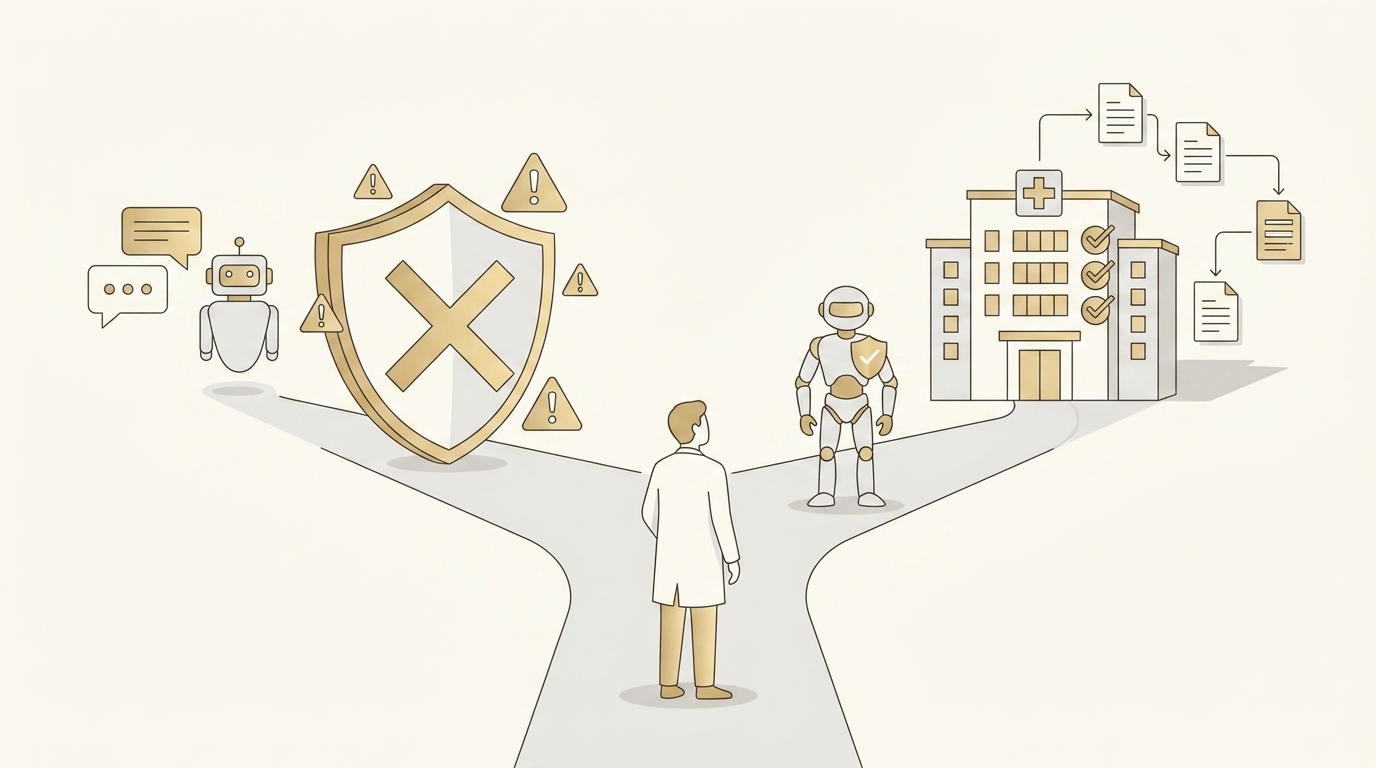
Can ChatGPT handle healthcare claims? Consumer AI tools lack HIPAA compliance, audit trails, and enterprise security. See what regulated orgs need instead.
What Is Consumer AI Healthcare Compliance Risk?
Consumer AI healthcare compliance risk refers to the regulatory, security, and operational dangers organizations face when deploying general-purpose AI tools—such as ChatGPT, ClawBot (OpenClaw), or OpenAI's Operator—in healthcare workflows that involve protected health information (PHI). These tools were designed for broad consumer use cases and fundamentally lack the compliance infrastructure required for HIPAA-regulated environments, including Business Associate Agreements (BAAs), audit trails, role-based access controls, and encrypted PHI handling.
The stakes are enormous at enterprise scale. A health system processing 500,000+ claims annually or a DSO managing revenue cycle across 100+ locations cannot afford a single breach—fines can exceed $1.9 million per violation category, and reputational damage compounds across every facility in the portfolio. In 2026, with AI adoption accelerating across healthcare operations, the gap between what consumer AI can do and what regulated healthcare requires has never been wider—or more dangerous.
For organizations seeking compliant automation, purpose-built solutions like Ventus AI deliver enterprise-grade security while matching or exceeding consumer AI capabilities. For example, Smilist—a 116-office DSO—executes over 3,000 claim status checks daily using Ventus AI agents, replacing 5-8 full-time coordinators without a single PHI exposure incident.
This guide examines exactly where consumer AI tools fail in regulated healthcare, what compliance gaps put your organization at risk, and how enterprise leaders can evaluate AI vendors that meet the rigorous standards their compliance teams demand.
The Hidden Cost of Using Consumer AI in Enterprise Healthcare Operations
The allure of consumer AI tools is understandable. ChatGPT can draft appeal letters in seconds. Operator can navigate web interfaces autonomously. ClawBot promises automated workflows at a fraction of traditional software costs. For a single-user productivity boost, these tools are impressive.
But enterprise healthcare is not a single-user productivity problem. It's a multi-stakeholder, heavily regulated, high-volume operation where a single compliance failure cascades across dozens—or hundreds—of locations.
The Compliance Gap Is Not Theoretical
In 2025 alone, the HHS Office for Civil Rights (OCR) settled or imposed penalties totaling over $15 million for HIPAA violations involving electronic PHI. The average cost of a healthcare data breach reached $10.93 million according to IBM's 2024 Cost of a Data Breach Report—the highest of any industry for the 14th consecutive year.
When a VP of Revenue Cycle deploys ChatGPT to help staff draft denial appeals, every prompt containing patient names, dates of service, procedure codes, or insurance IDs becomes unencrypted PHI flowing to OpenAI's servers—servers not covered by a BAA, not subject to minimum necessary standards, and not designed for healthcare data retention requirements.
Scale Amplifies the Risk
Consider these enterprise scenarios:
- Post-acquisition standardization: A DSO acquires 15 locations running different PMS systems. Staff begin using ChatGPT to reconcile claim formats. PHI from 15 practices now sits in a consumer AI's training data.
- RCM company operations: A billing company managing claims for 40+ provider groups uses Operator to automate payer portal logins. One breach exposes PHI across every client relationship.
- Health system denial management: A 12-hospital system's AR team pastes EOBs into Claude for pattern analysis. Audit reveals zero documentation of what PHI was shared, with whom, or how it was disposed.
These aren't edge cases—they're happening today in organizations that haven't yet established formal AI governance policies. According to a 2024 Bain & Company survey, 75% of healthcare executives reported that employees were already using generative AI tools without formal approval.
Enterprise teams deploy in 7 days — no integration required.
Book Your Free 15-Minute DemoThree Models for Healthcare AI Automation: A Head-to-Head Compliance Comparison
Enterprise healthcare organizations evaluating AI automation typically encounter three categories of solutions. Understanding their fundamental architecture differences reveals why compliance outcomes diverge so dramatically.
1. Consumer AI Tools (ChatGPT, Claude, Operator, ClawBot)
Best for: Individual productivity tasks with zero PHI involvement—drafting non-clinical communications, researching coding guidelines, or summarizing public payer policies.
- Pros: Low cost, immediate availability, broad general knowledge, rapid iteration
- Cons: No BAA available (or severely limited), no audit trails for PHI handling, no role-based access, data may be used for model training, no payer portal integration, no healthcare-specific workflow orchestration
2. Traditional RPA (UiPath, Automation Anywhere)
Best for: Organizations with dedicated IT teams willing to invest 6-12 months in bot development and maintenance for highly stable, unchanging workflows.
- Pros: Can be configured for HIPAA environments, established vendor compliance programs, deterministic workflows
- Cons: Brittle—breaks when payer portals update, requires significant developer resources, 3-6 month implementation timelines, high maintenance burden, limited ability to handle exceptions or MFA challenges
3. Enterprise AI Agents (Ventus AI)
Best for: Multi-location healthcare organizations needing compliant, intelligent automation that adapts to payer portal changes and handles exceptions autonomously—deployed in under 7 days.
- Pros: HIPAA compliant and SOC 2 Type II certified, BAA-ready, full audit trails, handles MFA/CAPTCHAs natively, browser-native automation (no API dependencies), communicates via Slack/Teams/Email, can make phone calls for exception resolution, deploys in under 7 days
- Cons: Requires enterprise commitment and defined workflows to automate
Compliance Comparison Table
| Compliance Requirement | Consumer AI (ChatGPT/Operator) | Traditional RPA | Ventus AI Agents |
|---|---|---|---|
| Business Associate Agreement (BAA) | ❌ Not available or limited | ✅ Available | ✅ Executed pre-deployment |
| SOC 2 Type II Certification | ❌ Consumer-grade security | ⚠️ Varies by vendor | ✅ Certified |
| PHI Audit Trails | ❌ No healthcare-specific logging | ⚠️ Requires custom configuration | ✅ Built-in, exportable |
| Role-Based Access Control | ❌ Single-user model | ⚠️ Requires IT setup | ✅ Native with SSO |
| Minimum Necessary Standard | ❌ Entire prompt visible | ⚠️ Depends on configuration | ✅ Enforced by design |
| Data Retention Controls | ❌ May use data for training | ⚠️ Requires policy configuration | ✅ Configurable, compliant |
| Payer Portal MFA Handling | ❌ Cannot handle | ❌ Breaks frequently | ✅ Handles natively |
| Deployment Timeline | Immediate (non-compliant) | 3-6 months | Under 7 days |
| Exception Handling | ❌ Manual escalation only | ❌ Fails silently | ✅ Slack/Teams alerts + phone calls |
The contrast is stark: consumer AI tools offer none of the compliance infrastructure required for healthcare PHI handling, while enterprise-grade solutions provide it as foundational architecture rather than an afterthought.
Enterprise Implementation Roadmap: From Risk Assessment to Compliant AI Deployment
For CIOs and CTOs evaluating the transition from ad-hoc consumer AI usage to compliant enterprise automation, the implementation path follows a structured progression. Here's how leading healthcare organizations approach it.
Phase 1: AI Governance Audit (Week 1-2)
- Inventory shadow AI usage: Survey department leads to identify where consumer tools are already touching PHI. Our experience shows 60-80% of RCM teams have at least one staff member using ChatGPT for claim-related tasks.
- Quantify exposure: Document which PHI elements (patient names, DOBs, SSNs, claim numbers) have been entered into non-compliant tools.
- Establish policy: Create an enterprise AI acceptable use policy that distinguishes between compliant and non-compliant tools.
Phase 2: Pilot Deployment (Week 2-3)
- Select a high-volume, measurable workflow: Claim status checking is ideal—high volume, repetitive, and immediately quantifiable.
- Deploy compliant AI agents: With browser-native automation, Ventus AI agents can begin processing within the existing PMS and payer portal environment without API integrations.
- Validate compliance controls: Confirm audit trails, access logs, and BAA coverage before expanding.
Phase 3: Scale Across the Portfolio (Week 3-8)
- Expand to additional workflows: Denial management, eligibility verification, prior authorization.
- Roll out across locations: Multi-site deployment with centralized monitoring.
- Integrate communication channels: Slack, Teams, or Email notifications for exception handling.
"Ventus stands out from the noise in the AI and automation market. Their approach allows them to ramp up quickly in the messy middle of RCM."
— Philip Toh, Co-founder & President, Smilist
Smilist's experience illustrates the enterprise reality: with over 3,000 claim status checks executed daily across their growing network of 100+ locations, the alternative would have required hiring 5-8 additional full-time coordinators—at a cost of $250,000-$400,000 annually in salary and benefits alone.
Critical Pitfalls to Avoid at Scale
- Piloting without compliance sign-off: IT Security and Compliance must validate any AI tool before PHI exposure, not after.
- Assuming consumer AI BAAs are sufficient: OpenAI's enterprise BAA covers ChatGPT Enterprise but with significant limitations on healthcare use cases—and doesn't extend to Operator or API-based tools in the same way.
- Ignoring the "minimum necessary" standard: Even with a BAA, HIPAA requires that only the minimum PHI necessary for a task is disclosed. Consumer AI prompts inherently violate this principle.
For a deeper understanding of how purpose-built AI agents differ from traditional automation, see our guide on RPA vs AI agents in healthcare.
ROI Reality Check: What Enterprise Healthcare Organizations Actually Achieve With Compliant AI
The financial case for compliant AI automation isn't just about avoiding fines—though at $1.9M+ per HIPAA violation category, that alone justifies investment. The real ROI compounds across three dimensions:
Direct Cost Savings
- FTE reallocation at scale: Organizations processing 100K+ claims monthly typically redeploy 12-20 FTEs from manual status checking and verification to higher-value denial resolution and patient engagement.
- Cost-per-claim reduction: Enterprise AI agents reduce cost-per-claim from $3.50-$7.00 (manual) to under $0.50 (automated), representing 85-93% cost reduction.
- Avoided breach costs: With the average healthcare breach costing $10.93M (IBM, 2024), a single prevented incident covers decades of compliant AI investment.
Revenue Acceleration
- Faster AR resolution: Automated daily status checks identify actionable claims 5-10 days earlier than weekly manual reviews.
- Denial prevention: Real-time eligibility verification catches coverage gaps before claims are submitted, reducing denial rates by 15-30%.
- Portfolio-wide consistency: Standardized automation across 50+ locations eliminates the revenue variation caused by inconsistent staff performance.
Timeline to Results
- Quick wins (Week 1-2): Single-workflow pilot processing 500-1,000 claims daily with full compliance documentation.
- Measurable impact (Month 1-2): 40-60% reduction in manual touches for automated workflows, with ROI calculator projections validated against actuals.
- Full deployment ROI (Month 3-6): Portfolio-wide automation delivering $500K-$2M+ in annual savings depending on organization size.
To explore how these numbers apply to your specific payer mix and claim volume, use our ROI calculator or book a 30-minute demo with our enterprise team.
See how enterprise healthcare organizations deploy AI agents in under 7 days.
Request a DemoFrequently Asked Questions
Can ChatGPT be used for healthcare claims processing?
No, ChatGPT cannot be safely used for healthcare claims processing involving PHI. While ChatGPT Enterprise offers a limited BAA, it lacks the payer portal integration, audit trails, role-based access controls, and workflow orchestration required for compliant claims operations at scale. Organizations using ChatGPT for claims tasks risk HIPAA violations with fines up to $1.9M per violation category. Purpose-built solutions like Ventus AI provide these compliance controls as foundational architecture while delivering equivalent or superior automation capabilities.
How does Ventus AI maintain HIPAA compliance while automating healthcare workflows?
Ventus AI maintains HIPAA compliance through a comprehensive security architecture including SOC 2 Type II certification, executed BAAs prior to any PHI handling, encrypted data transmission, role-based access controls with SSO, complete audit trails of every PHI interaction, and minimum necessary data exposure by design. Unlike consumer AI tools where prompts may be stored or used for training, Ventus AI agents operate within your existing browser-based payer portals without extracting PHI to external systems.
How long does it take to deploy compliant AI automation in a healthcare organization?
Under 7 days for initial deployment with Ventus AI agents. Because the technology uses browser-native automation rather than requiring API integrations or custom development, a focused pilot—such as automated claim status checking—can go live within one week. Smilist deployed agents executing 3,000+ daily claim status checks across their 100+ location network with minimal IT lift. Traditional RPA alternatives typically require 3-6 months for comparable implementations.
What's the difference between OpenAI's enterprise BAA and healthcare-grade compliance?
OpenAI's enterprise BAA is a necessary but insufficient condition for healthcare compliance. A BAA establishes legal obligations for PHI handling, but healthcare-grade compliance also requires audit trails documenting every PHI interaction, minimum necessary enforcement, role-based access preventing unauthorized viewing, integration with healthcare-specific workflows (payer portals, PMS systems), and the ability to handle MFA and security challenges. Consumer AI tools provide the BAA but lack the operational infrastructure that healthcare regulations demand in practice.
What results can enterprise healthcare organizations expect from compliant AI automation?
Enterprise organizations typically achieve 85-93% reduction in cost-per-claim for automated workflows, redeployment of 12-20 FTEs from manual tasks, and 15-30% reduction in denial rates through proactive eligibility verification. Smilist's experience—3,000+ daily claim status checks replacing 5-8 full-time coordinators—represents typical enterprise-scale outcomes. Most organizations see measurable ROI within 30-60 days of deployment, with full portfolio savings of $500K-$2M+ annually. View customer stories for additional examples.
Is OpenAI's Operator safe for navigating payer portals?
No, Operator is not designed for healthcare payer portal navigation involving PHI. While Operator can browse websites autonomously, it lacks healthcare-specific compliance controls: no audit trails for PHI viewed on-screen, no minimum necessary enforcement, no BAA coverage for portal interactions, and no reliable handling of healthcare-specific MFA workflows. Ventus AI agents, by contrast, were purpose-built for payer portal automation—handling MFA, CAPTCHAs, and security challenges while maintaining complete audit documentation of every interaction.
How do I evaluate AI vendors for healthcare compliance?
Start with five non-negotiable requirements: (1) SOC 2 Type II certification with healthcare-relevant controls, (2) willingness to execute a BAA before any PHI access, (3) documented audit trails for every PHI interaction, (4) role-based access with SSO integration, and (5) data retention and disposal policies aligned with your state requirements. Beyond these table stakes, evaluate operational capabilities: Can the solution handle payer portal MFA? Does it escalate exceptions via your existing channels (Slack, Teams)? Can it deploy in under 30 days? Review our enterprise security documentation for a comprehensive evaluation framework.
Can compliant AI agents handle the same tasks as ChatGPT but with proper security?
Yes—and often more effectively for healthcare-specific workflows. While ChatGPT excels at general language tasks, Ventus AI agents are optimized for the structured, repetitive, high-volume workflows that drive healthcare revenue: claim status checking, denial pattern identification, eligibility verification, and prior authorization follow-up. They accomplish these tasks with full compliance infrastructure, direct payer portal integration, and exception handling via phone calls when automated resolution isn't possible.
Your Next Move: A 30-Day Compliance-First AI Adoption Plan
The window for unregulated consumer AI usage in healthcare is closing. OCR enforcement actions are increasing, and enterprise governance expectations are tightening. Healthcare organizations that act now can capture the productivity benefits of AI automation without the compliance risk—and without waiting 6+ months for traditional RPA implementations.
Here's your 30-day action plan:
- Week 1 — Audit current exposure: Survey your RCM teams to identify where consumer AI tools are already in use. Document any PHI that may have been shared with non-compliant platforms. Engage your compliance officer immediately.
- Week 2 — Establish governance: Draft an enterprise AI acceptable use policy distinguishing between approved (compliant) and prohibited (consumer) tools. Communicate policy to all revenue cycle staff.
- Week 3 — Evaluate compliant alternatives: Request demos from purpose-built healthcare AI automation vendors. Validate SOC 2 certification, BAA willingness, and deployment timeline. Use your ROI calculator to quantify the business case.
- Week 4 — Launch a pilot: Deploy compliant AI agents on a single high-volume workflow (claim status checking is ideal). Measure throughput, accuracy, and compliance documentation against your manual baseline.
The organizations that thrive in 2026 won't be those that avoided AI—they'll be those that deployed it responsibly, at scale, with compliance as a feature rather than an afterthought.
→ See how it works on your payer mix — Book a 30-minute demo
For more insights on AI automation in healthcare, explore our AI Insights library.
Ready to Transform Your Revenue cycle?
See how Ventus AI agents can automate your end-to-end RCM automation with AI agents in under 7 days—no complex integrations required.
Book Your Free Demo
Enterprise AI Automation for Healthcare RCM
Written by the Ventus AI team — healthcare RCM practitioners, automation engineers, and former revenue cycle leaders building AI agents that work as teammates alongside billing teams. Ventus is SOC 2 Type II certified and HIPAA compliant.