
On this page
- What is RPA to AI Agents Migration in Enterprise Healthcare?
- The Breaking Point: Why Enterprise RPA Programs Are Failing at Scale
- Three Automation Models for Enterprise Healthcare: A Head-to-Head Comparison
- Enterprise Implementation Roadmap: From RPA Sunset to Full AI Agent Deployment
- ROI Reality Check: What Enterprise Healthcare Organizations Actually Achieve
- Your Next Move: 90-Day Enterprise Migration Action Plan
What is RPA to AI Agents Migration in Enterprise Healthcare?
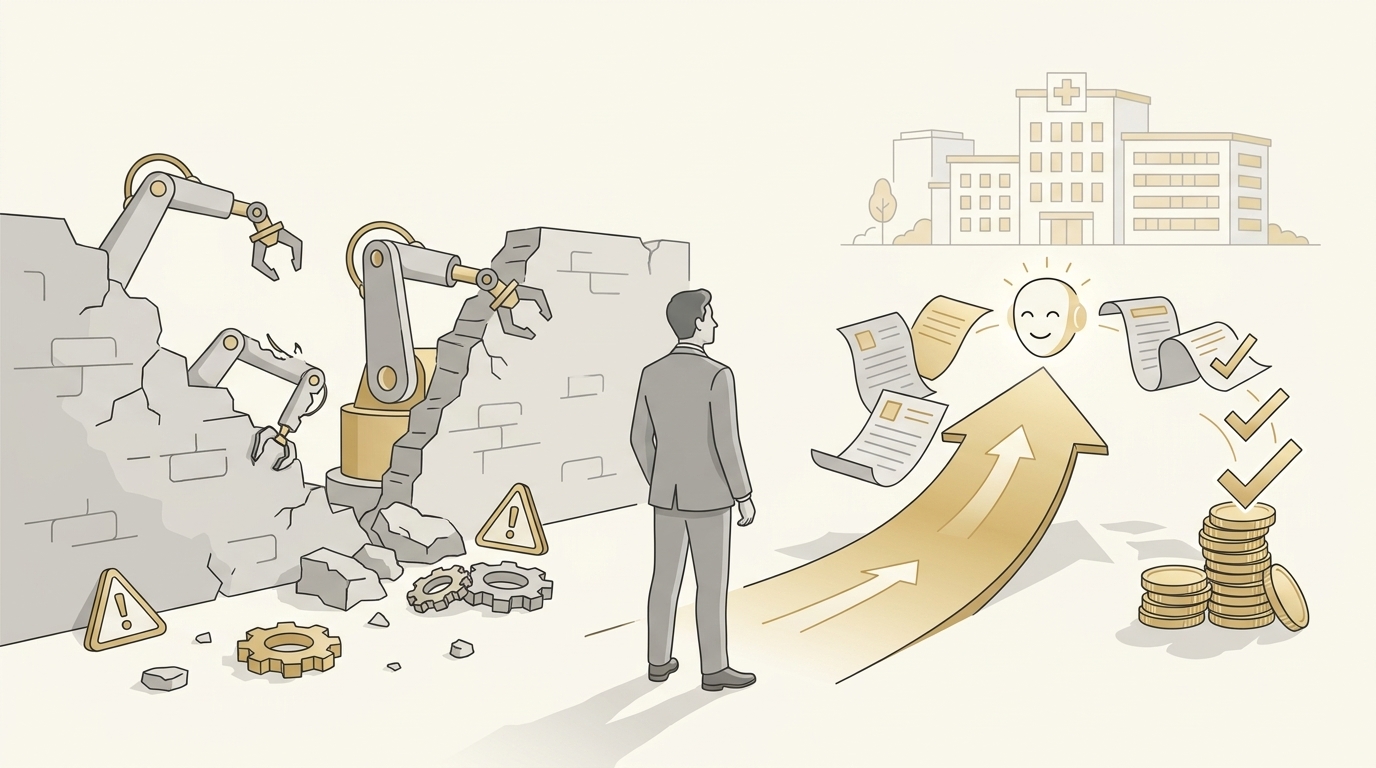
RPA to AI agents migration is the strategic shift from rigid, rule-based robotic process automation (RPA) bots to intelligent AI agents capable of reasoning, adapting, and handling exceptions across complex healthcare workflows. Unlike traditional RPA—which breaks when a portal changes a button color or adds a CAPTCHA—AI agents understand context, navigate dynamic interfaces, and resolve exceptions that previously required human intervention.
For enterprise healthcare organizations managing millions of claims annually, this migration represents a fundamental shift in operational capacity. Where RPA delivered 40-60% automation coverage before stalling at exceptions, AI agents achieve 85-95% end-to-end task completion—including the "messy middle" of denials, appeals, and payer-specific edge cases that consume the most FTE hours.
Ventus AI deploys browser-native AI agents that execute tasks like claim status checks, prior authorizations, and denial follow-ups across any payer portal—without API integrations. Smilist, a 116-office DSO, executes over 3,000 claim status checks daily with Ventus AI agents, replacing work that would require 5-8 full-time billing coordinators. That's the scale of impact driving this migration wave across enterprise healthcare in 2026.
This guide provides the complete playbook for CIOs, CTOs, and enterprise operations executives evaluating the RPA-to-AI-agents transition—covering the business case, technical architecture decisions, implementation timelines, compliance requirements, and ROI benchmarks based on real enterprise deployments.
The Breaking Point: Why Enterprise RPA Programs Are Failing at Scale
The promise of RPA in healthcare was compelling: automate repetitive tasks, reduce FTE costs, and improve accuracy. Between 2018 and 2023, health systems and RCM companies invested heavily in RPA platforms. By 2025, the cracks became undeniable.
The Maintenance Burden
Enterprise RPA programs require dedicated teams just to keep bots running. According to Gartner, organizations spend 30-50% of their initial RPA investment annually on maintenance alone. Every payer portal update, every UI change, every new security flow triggers bot failures that require developer intervention. For a health system working with 300+ payers, this creates a perpetual break-fix cycle.
The Exception Problem
RPA bots follow scripts. When they encounter anything outside their programmed logic—an unexpected denial code, a new CAPTCHA type, a portal redesign—they stop and create a queue for human workers. In enterprise healthcare, 35-45% of transactions involve some form of exception. This means RPA programs hit a ceiling where the volume of exceptions routed back to humans erodes most of the projected ROI.
The Scale Paradox
As organizations add more bots, complexity compounds. A large medical group managing 150,000+ claims monthly reported maintaining 47 separate RPA bots across different payer portals—each requiring individual updates when portals changed. Their annual RPA maintenance cost exceeded $1.2M, while still requiring 22 FTEs to handle exceptions the bots couldn't resolve.
Integration Fragility
Traditional RPA requires either screen-scraping (fragile) or API connections (limited availability). Most payer portals don't offer APIs for claim status or prior authorization workflows. When health systems grow through M&A—integrating new practices with different PMS/EHR systems—RPA bots built for one system can't transfer to another without complete rebuilds.
These compounding failures explain why Forrester reported that 52% of enterprise RPA programs fail to meet initial ROI projections within 24 months. The technology works for simple, static processes—but healthcare revenue cycle operations are neither simple nor static. Organizations need enterprise security and adaptability that legacy RPA cannot deliver.
Ventus for multi-location groups
Tend removed 50% of its outsourced verification load in two months across 33 locations.
Book a DemoThree Automation Models for Enterprise Healthcare: A Head-to-Head Comparison
Enterprise healthcare organizations evaluating their automation future have three primary options. Each carries different risk profiles, scalability limits, and total cost of ownership.
1. Traditional RPA (UiPath, Automation Anywhere, Blue Prism)
Best for: Simple, high-volume, unchanging workflows with stable portal interfaces
Pros:
- Established vendor ecosystem with large implementation partners
- Mature governance frameworks for bot management
- Strong audit trails for compliance-sensitive organizations
Cons:
- High maintenance costs (30-50% of initial investment annually)
- Breaks on portal changes requiring developer fixes within hours
- Cannot handle MFA, CAPTCHAs, or dynamic security flows
- No reasoning capability — stops at any exception outside programmed logic
- Requires API or screen-scraping — fragile at scale
2. Consumer AI Tools (ChatGPT, Operator, Generic Agents)
Best for: Ad-hoc individual productivity tasks, not enterprise healthcare workflows
Pros:
- Low upfront cost for individual users
- Rapid iteration with general-purpose intelligence
- Accessible without technical implementation
Cons:
- No HIPAA compliance — cannot process PHI
- No BAA availability — unacceptable risk for healthcare organizations
- No audit trails meeting enterprise compliance standards
- No payer portal expertise — doesn't understand healthcare-specific workflows
- No SOC 2 certification for enterprise security requirements
3. Enterprise AI Agents (Purpose-Built for Healthcare)
Best for: Multi-location healthcare organizations needing adaptive, compliant automation across complex payer ecosystems
Pros:
- Handles exceptions autonomously through reasoning and adaptation
- Navigates MFA, CAPTCHAs, and security flows without human intervention
- No API required — browser-native automation works on any portal
- HIPAA compliant with BAA and SOC 2 Type II certification
- Sub-7-day deployment with no integration dependencies
- Self-healing — adapts to portal changes without developer intervention
Cons:
- Newer category with fewer long-term deployment case studies
- Requires trust-building with compliance teams unfamiliar with AI agents
Enterprise Comparison: RPA vs Consumer AI vs AI Agents
| Capability | Traditional RPA | Consumer AI Tools | Ventus AI Agents |
|---|---|---|---|
| Exception handling | Routes to humans | Not applicable | Autonomous resolution |
| Portal change resilience | Breaks immediately | Not applicable | Self-adapting |
| MFA/CAPTCHA handling | Cannot handle | Cannot handle | Native support |
| HIPAA compliance | Varies by setup | Not compliant | SOC 2 Type II + BAA |
| Deployment timeline | 3-6 months | N/A | Under 7 days |
| API requirement | Yes (or screen scrape) | N/A | None — browser-native |
| Maintenance burden | 30-50% annually | N/A | Included in service |
| Healthcare payer expertise | Generic scripting | None | Purpose-built |
| Scalability across payers | Linear cost increase | Not applicable | Flat architecture |
| Phone-based follow-up | Cannot | Cannot | AI-powered calls |
This comparison explains why organizations are moving beyond the RPA vs AI agents debate and into active migration planning.
Enterprise Implementation Roadmap: From RPA Sunset to Full AI Agent Deployment
Migrating from RPA to AI agents doesn't require a risky "rip and replace" approach. The most successful enterprise deployments follow a phased methodology that de-risks the transition while delivering immediate value.
Phase 1: Parallel Pilot (Weeks 1-2)
Deploy AI agents alongside existing RPA bots on a single high-volume workflow—typically claim status checking or eligibility verification. This allows direct performance comparison without disrupting operations.
Key success factors:
- Select your highest-exception workflow — this showcases AI agent advantage most clearly
- Define clear KPIs — task completion rate, exception resolution rate, turnaround time
- Include your compliance team early — review audit trails, data handling, and access controls
- Start with one payer portal — prove capability, then expand
Phase 2: Expansion and RPA Sunsetting (Weeks 3-6)
Once pilot results validate performance, expand AI agents across additional payer portals and workflow types. Begin sunsetting RPA bots on migrated workflows.
Common pitfalls to avoid:
- Trying to migrate all bots simultaneously — prioritize by maintenance cost and exception rate
- Neglecting change management — billing teams need visibility into AI agent activity via Slack or Teams
- Skipping the compliance review — ensure SOC 2 and HIPAA compliance documentation satisfies your legal team before full expansion
- Underestimating the MFA challenge — verify AI agents handle your specific payer portal security flows
Phase 3: Full Production and Optimization (Weeks 6-12)
AI agents assume full production responsibility for migrated workflows. RPA licenses are retired. Teams shift from bot maintenance to exception monitoring and strategic improvement.
"Ventus stands out from the noise in the AI and automation market. Their approach allows them to ramp up quickly in the messy middle of RCM."
— Philip Toh, Co-founder & President, Smilist
Smilist's deployment demonstrates the enterprise migration path in action. By replacing manual claim status processes with AI agents executing 3,000+ daily checks, they eliminated the need for 5-8 full-time coordinators while improving accuracy and turnaround time across their growing portfolio of 100+ locations.
You can explore the ROI calculator to model similar results for your organization's specific claim volume and payer mix.
ROI Reality Check: What Enterprise Healthcare Organizations Actually Achieve
The financial case for RPA-to-AI-agent migration extends beyond simple FTE replacement. Enterprise organizations realize value across multiple dimensions:
Direct Cost Savings
- RPA license elimination: Enterprise RPA platforms cost $150K-$500K+ annually in licensing alone. AI agent platforms typically deliver 3-5x more automation at comparable or lower total cost.
- Maintenance team redeployment: The 3-5 developers maintaining RPA bots can be reassigned to higher-value projects. At average healthcare IT salaries, this represents $400K-$750K in recovered capacity.
- FTE reduction in operations: AI agents handling claim status, eligibility, and prior auth work replace 5-15 FTEs per 100,000 monthly claims, depending on payer mix complexity.
Revenue Acceleration
- Faster denial identification: AI agents check claim status within 24-48 hours of submission vs. 14-30 day manual cycles, catching denials weeks earlier.
- Higher clean claim rates: Exception resolution during initial submission improves first-pass acceptance rates by 12-18%.
- Reduced days in AR: Organizations report 15-25 day reductions in average AR days when AI agents handle status and follow-up.
Timeline to Results
- Quick wins (Days 1-14): Single-workflow pilot processing 500-3,000+ transactions daily with measurable completion rates
- Meaningful ROI (Weeks 4-8): Full workflow migration delivering measurable FTE savings and cycle time improvements
- Strategic transformation (Months 3-6): Portfolio-wide deployment enabling M&A integration acceleration and margin expansion
For a detailed analysis of how to calculate AI ROI for automation projects, including frameworks specific to healthcare revenue cycle, see our comprehensive guide.
Your payers. Your systems.
One central setup. Multi-location groups go live in about a month.
Book a DemoYour Next Move: 90-Day Enterprise Migration Action Plan
The RPA-to-AI-agent migration isn't a theoretical future—it's happening now across enterprise healthcare. Organizations that delay face compounding costs: rising RPA maintenance, growing exception queues, and competitive disadvantage as peers accelerate their revenue cycles.
Here's your 90-day action plan:
- Week 1-2: Audit your RPA program — Document total cost of ownership including licenses, maintenance FTEs, and exception handling costs. Identify your highest-maintenance, highest-exception workflows as migration candidates.
- Week 2-3: Evaluate AI agent platforms — Assess HIPAA compliance, SOC 2 certification, deployment timelines, and payer portal coverage. Prioritize vendors with healthcare-specific expertise and browser-native architecture.
- Week 3-4: Launch parallel pilot — Deploy AI agents alongside existing RPA on one workflow. Measure completion rates, exception resolution, and cycle time against current baselines.
- Week 5-8: Expand and validate — Scale to additional payer portals and workflows based on pilot results. Begin sunsetting RPA bots on validated processes.
- Week 8-12: Full migration and optimization — Complete portfolio-wide deployment. Retire RPA licenses. Redeploy maintenance teams to strategic initiatives.
The organizations executing this playbook in 2026 will carry structural cost advantages into 2027 and beyond. Those maintaining legacy RPA will continue spending more to accomplish less.
For healthcare-specific AI automation across dental and medical RCM workflows, explore how Ventus AI agents integrate across your entire payer ecosystem—and browse more AI insights from our enterprise automation library.
→ See how it works on your payer mix — Book a 30-minute demo