
On this page
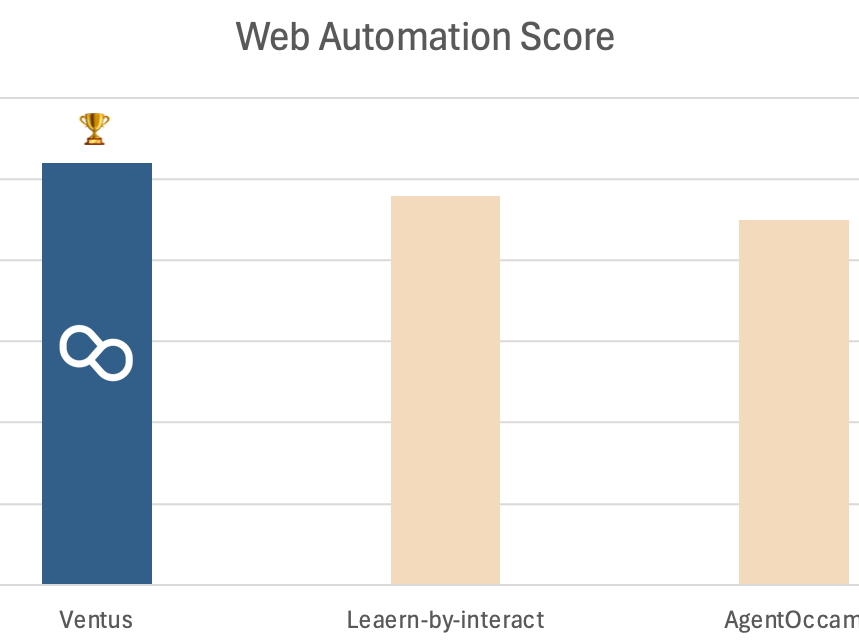
Ventus, in collaboration with UNC, co-developed an AI agent specializing in web automation, achieving top performance in research benchmarks for web navigation and automation among open-source solutions.
In real-world tasks—such as data entry into payer portals and practice management systems, Ventus' agent outperforms significantly. It completes tasks at 1/14th the cost and 1/11th the time compared to frontier models like OpenAI CUA.
Accurate, Efficient, and Secure for the Real World
Frontier labs like OpenAI are advancing rapidly in developing larger, more powerful models with reasoning capabilities akin to "super intelligence" (e.g., the IQ of a Math PhD).
However, in real-world scenarios, these models are:
- Overkill and expensive to operate — most tasks don't need super intelligence
- Require all the data to be sent online
- Closed-source, making them opaque — requiring users to rely on a black box for their crucial operations
Addressing these concerns is crucial if we aim to deploy these models for critical tasks in healthcare and enterprise operations effectively.
Ventus is adopting a unique approach by prioritizing models that are both efficient and secure. Our solutions deliver competitive performance compared to closed-source options like OpenAI, while significantly outperforming other open-source alternatives.
We also developed a mode that keeps all sensitive data local instead of sending all of it to the cloud — it almost doubled the accuracy over previous results.
This innovation is particularly impactful for industries such as healthcare, insurance, and financial services where privacy and efficiency are paramount. Smaller models have the advantage of running locally, providing a strong filter for sensitive information like PHI and significantly improving data privacy. Moreover, their reduced size and minimal resource requirements make automation more accessible and cost-effective.
Our Approach: AgentSymbiotic Framework
Our approach involves a "symbiotic" partnership between two types of AI models:
• Large Language Models (LLMs): Highly sophisticated models capable of understanding complex tasks and generating high-quality execution strategies. • Small, Efficient LLMs: These models learn and distill knowledge from their larger counterparts, becoming more efficient, faster, and cost-effective at performing tasks.
Through a novel framework called AgentSymbiotic, our small LLMs not only replicate the success of large LLMs but also explore and discover innovative solutions. By doing so, they enrich the overall intelligence and performance of our large LLMs in a continuous, iterative improvement cycle.
Key innovations include:
• Iterative Learning: Small LLMs learn from the rich, detailed knowledge provided by large LLMs, refining their abilities over time. • Speculative Data Synthesis: Small LLMs proactively explore new ways to solve tasks, allowing the entire system to discover better, more efficient methods, which continuously enhances the capabilities of both LLM types. • Multi-task Learning: Small LLMs don't just copy the actions; they also learn the reasoning behind these actions, significantly improving their decision-making and problem-solving skills. • Hybrid Privacy Mode: Small LLMs are also deployed locally for tasks involving sensitive information, taking on the responsibility to ensure critical data remains private and secure, filtering out sensitive details autonomously.
Applications in Healthcare and Enterprise
Healthcare and enterprise businesses thrive on efficiency and accuracy. Yet, countless hours are lost every day to routine, repetitive tasks—like claim statusing, eligibility verification, data entry, or complex scheduling. At Ventus, we've developed cutting-edge AI solutions that autonomously integrate with cloud-based portals—even those without APIs—transforming how operations are conducted.
Why This Matters for Healthcare RCM
In dental and medical RCM, our AI agents navigate 300+ payer portals, handle MFA and CAPTCHAs, and process claims at scale. The same technology that achieves #1 benchmark performance powers real-world workflows:
- Bulk claim status checks across multiple payers
- Automated denial management and appeal filing
- Insurance eligibility verification
- AR follow-up and collections
With browser-native agents that handle MFA, CAPTCHAs, and even phone calls, most teams are live in under seven days.
Technical Resources
For more details on our approach, please refer to the project website and the technical writeup.
Interested in seeing how our AI agents can automate your workflows? Book a demo to learn more.
Ventus AI applies this technology to dental RCM and medical RCM workflows. Learn about our enterprise security and compliance certifications, or schedule a demo to see it in action.