
Browser-native AI agents let healthcare enterprises automate without APIs or IT projects. Learn why CIOs are replacing RPA with browser-based AI in 2026.
What Are Browser-Native AI Agents?
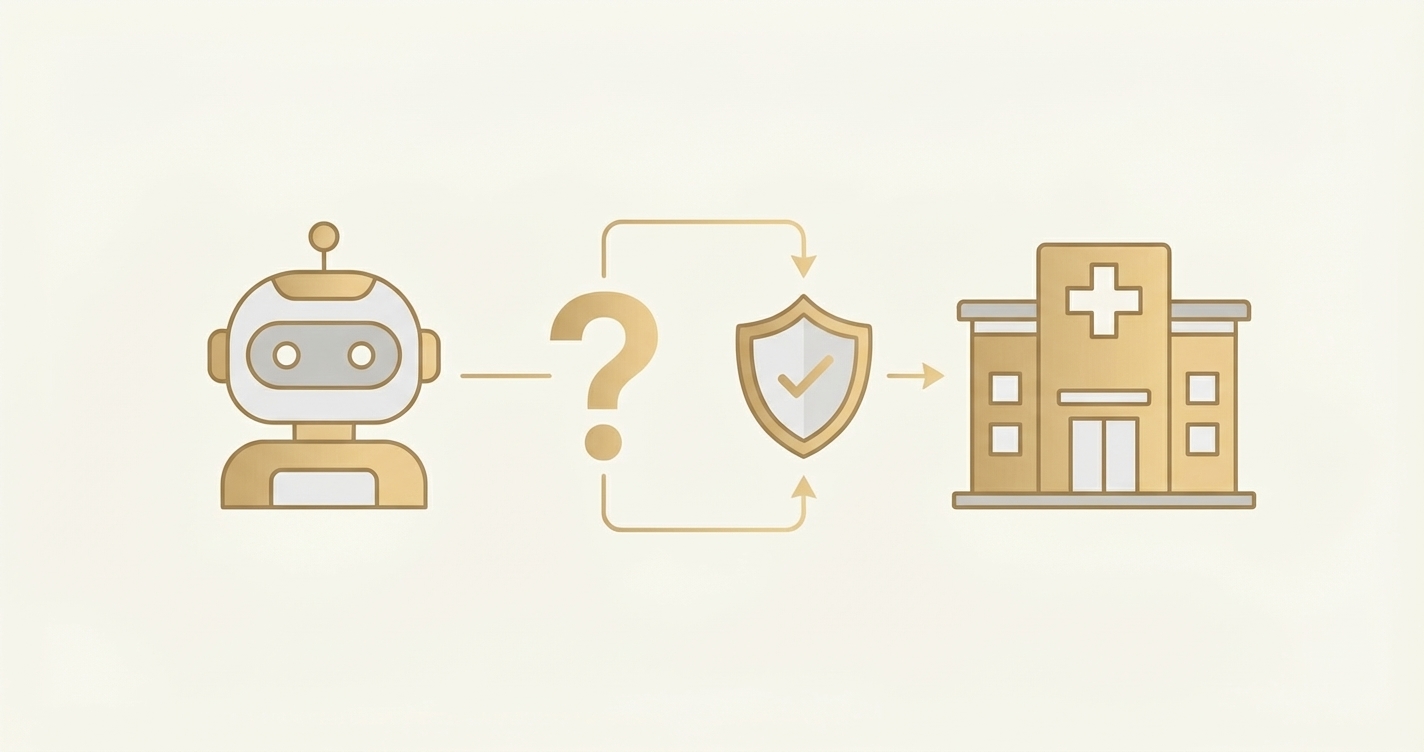
Browser-native AI agents are autonomous software workers that interact with web-based applications exactly the way a human employee would—through a browser interface—rather than requiring custom API integrations, database access, or legacy RPA scripted bots. They navigate payer portals, EHR systems, clearinghouses, and practice management platforms by reading screens, clicking buttons, filling forms, handling multi-factor authentication, and even solving CAPTCHAs—all without a single line of integration code.
For enterprise healthcare organizations managing thousands of claims daily across dozens of payer portals, this architectural distinction is transformative. Traditional automation approaches—APIs and robotic process automation (RPA)—have promised efficiency for over a decade, yet most health systems and DSOs still rely on armies of coordinators to manually check claim statuses, verify eligibility, and follow up on denials. The reason is simple: payer portals don't offer reliable APIs, and RPA bots break every time a portal updates its UI.
Ventus AI deploys browser-native AI agents purpose-built for healthcare revenue cycle operations. Smilist, a DSO scaling to 100+ locations, now executes over 3,000 claim status checks daily using Ventus agents—work that previously required 5–8 full-time coordinators. That's the scale of impact this technology enables: not marginal efficiency gains, but structural FTE reduction across an entire portfolio.
In this guide, we'll break down why enterprise healthcare CIOs and operations executives are abandoning API-dependent and RPA-based automation in favor of browser-native AI agents in 2026. You'll learn the technical differences between the three approaches, see a head-to-head comparison, understand the implementation roadmap, and walk away with a 90-day action plan for your organization.
The Hidden Cost of API Dependency and RPA Fragility Across a Growing Healthcare Organization
Enterprise healthcare organizations face a compounding automation problem. Every new payer contract, every M&A integration, and every portal UI update introduces friction that traditional automation can't absorb.
The API Mirage
APIs are the gold standard of software integration—when they exist. In healthcare revenue cycle management, they usually don't. The average health system interacts with 30–50 distinct payer portals, and fewer than 20% offer stable, publicly documented APIs for claim status, eligibility, or prior authorization workflows. Even when APIs exist, they often lag behind portal functionality by months, require expensive custom development, and demand ongoing maintenance as payer specifications evolve.
For a health system processing 150,000+ claims per month across multiple facilities, building and maintaining API integrations with each payer is a multi-year IT initiative requiring dedicated engineering headcount. The total cost of ownership often exceeds $500K annually before a single claim is touched.
The RPA Brittle-Bot Problem
RPA was supposed to solve the API gap. Traditional RPA tools like UiPath and Automation Anywhere record scripted workflows—"click here, type there, wait for this element." The problem? Payer portals change their interfaces constantly. A single CSS class name change or a relocated button can break an entire bot fleet overnight.
Enterprise RPA deployments in healthcare typically experience 30–40% bot failure rates within 6 months of deployment, according to Gartner research on RPA reliability. Each failure requires a developer to re-record or re-script the workflow—creating a permanent maintenance burden that scales linearly with the number of portals and workflows automated.
The Real Enterprise Pain
Consider a DSO that acquires 15 new locations in a year. Each acquisition brings different practice management systems, different payer mixes, and different portal workflows. With API-based automation, the IT team faces months of integration work per system. With RPA, they face weeks of bot scripting per portal—and ongoing maintenance after every portal update.
The result? Most organizations default to manual labor. They hire more coordinators, accept higher cost-per-claim ratios, and watch margins compress as they scale. According to MGMA data, revenue cycle labor costs represent 3–5% of net patient revenue for the average multi-location healthcare organization—a figure that grows disproportionately during periods of rapid expansion.
This is why enterprise healthcare leaders are actively seeking a third path. And it's why enterprise security and compliance are non-negotiable requirements for any automation vendor entering this space.
Enterprise teams deploy in 7 days — no integration required.
Book Your Free 15-Minute DemoThree Models for Enterprise Healthcare Automation: A Head-to-Head Comparison
Enterprise healthcare organizations evaluating automation technology in 2026 face three distinct architectural approaches. Each has legitimate use cases—but their strengths and weaknesses diverge sharply when applied to revenue cycle workflows at scale.
1. API-Based Integration
Best for: Organizations with a small, stable payer mix where payers offer well-documented, reliable APIs.
- Pros: Fastest data transfer speeds; most reliable when APIs are stable; clean structured data exchange
- Cons: Rarely available for payer portal workflows; requires dedicated engineering resources; months-long implementation per payer; breaks when API specs change; total cost of ownership escalates with payer count
2. Traditional RPA (Robotic Process Automation)
Best for: Highly stable, repetitive workflows on internal systems that rarely change their UI.
- Pros: Works without APIs; familiar to IT teams; large vendor ecosystem; can automate internal EHR workflows
- Cons: Brittle—breaks with any UI change; requires scripted workflows per portal; 30–40% failure rates within 6 months; high maintenance developer overhead; cannot handle MFA or CAPTCHAs natively; poor exception handling
3. Browser-Native AI Agents
Best for: Enterprise healthcare organizations automating across dozens of payer portals, clearinghouses, and PM systems at scale—especially during M&A integration.
- Pros: No API required; no scripted bots to maintain; handles MFA, CAPTCHAs, and dynamic UIs; deploys in days not months; scales across payer mixes without per-portal development; AI-driven exception handling; communicates via Slack, Teams, and email; can make phone calls to resolve edge cases
- Cons: Requires trust in a newer architectural paradigm; browser-speed throughput (vs. API-speed); vendor selection is critical—consumer AI tools lack healthcare compliance
Comparison Table: API vs. RPA vs. Browser-Native AI Agents
| Capability | API Integration | Traditional RPA | Ventus AI Agents |
|---|---|---|---|
| Payer portal coverage | < 20% of portals | All portals (when scripted) | All portals (no scripting) |
| Deployment time per payer | 2–6 months | 2–6 weeks | Under 7 days |
| Handles MFA & CAPTCHAs | No | Rarely | Yes |
| Maintenance burden | Medium (API spec changes) | High (UI changes break bots) | Low (AI adapts to UI changes) |
| Exception handling | Manual escalation | Manual escalation | AI triage + phone/email follow-up |
| HIPAA & SOC 2 compliance | Depends on vendor | Depends on vendor | Yes (SOC 2 Type II, BAA-ready) |
| Scales with M&A growth | Poorly (per-payer dev) | Poorly (per-portal scripting) | Well (agent learns new portals) |
| Total cost of ownership (50+ portals) | $500K+/year | $300K+/year | Fraction of FTE equivalent |
The architectural advantage of browser-native AI agents is clear: they eliminate both the API availability problem and the RPA brittleness problem simultaneously. For organizations managing complex payer mixes across multiple locations, this is a fundamental shift in what's automatable.
Enterprise Implementation Roadmap: From Single-Site Pilot to Portfolio-Wide Deployment
Deploying browser-native AI agents at enterprise scale follows a distinct pattern. The organizations that achieve the fastest ROI treat implementation as a phased rollout—not a big-bang project.
Phase 1: Focused Pilot (Days 1–7)
Select a single high-volume workflow at one site—typically claim status checking or eligibility verification. Ventus AI agents deploy in under 7 days with no API integrations, no IT infrastructure changes, and no EHR modifications required. The agent logs into the same portals your team uses, through the browser, and begins processing.
- Pitfall to avoid: Boiling the ocean. Don't try to automate every workflow simultaneously. Start with the highest-volume, most repetitive task where manual effort is most measurable.
- Success factor: Executive sponsorship. Ensure your VP of Revenue Cycle or CIO has direct visibility into pilot metrics from day one via Slack or Teams updates.
Phase 2: Validation and Expansion (Weeks 2–4)
Measure pilot results against baseline FTE effort, turnaround time, and error rates. Use the ROI calculator to model portfolio-wide impact based on actual pilot data—not theoretical projections.
- Pitfall to avoid: Skipping the measurement baseline. Without pre-automation metrics, you cannot demonstrate ROI to the CFO. Document current FTE hours, cost-per-claim, and days in AR before the pilot begins.
- Success factor: Expand by workflow, then by site. Add denial follow-up or insurance verification automation at the pilot site before rolling to new locations.
Phase 3: Portfolio-Wide Rollout (Months 2–3)
Deploy across all locations, standardizing workflows and escalation protocols. Browser-native agents adapt to different portal interfaces without per-site scripting, making multi-location expansion dramatically faster than RPA alternatives.
- Pitfall to avoid: Ignoring change management. Revenue cycle staff need to understand that AI agents are teammates handling repetitive portal work—freeing them for complex appeals, patient interactions, and exception resolution.
- Success factor: Centralized monitoring. Use role-based dashboards with SSO-compatible access so regional managers and central leadership share a single source of truth.
"Ventus stands out from the noise in the AI and automation market. Their approach allows them to ramp up quickly in the messy middle of RCM."
— Philip Toh, Co-founder & President, Smilist
Smilist's experience illustrates the enterprise deployment pattern: rapid pilot, measurable results, and confident portfolio expansion. Their agents now execute over 3,000 daily claim status checks—replacing work that would require 5–8 full-time coordinators—across a DSO scaling to 100+ locations.
ROI Reality Check: What Enterprise Healthcare CIOs and CFOs Actually Achieve
Browser-native AI agents deliver ROI across three dimensions that matter most to enterprise healthcare leadership: direct labor savings, revenue acceleration, and operational scalability.
Direct Cost Reduction
- FTE redeployment: Organizations typically redeploy 40–60% of revenue cycle coordinators from manual portal work to higher-value activities like complex appeals and patient engagement. At an average fully-loaded cost of $45,000–$55,000 per coordinator, a 50-location organization reallocating 10 FTEs achieves $450K–$550K in annual savings.
- Maintenance cost elimination: Unlike RPA, browser-native agents require no per-portal scripting maintenance. Organizations running 30+ payer portal automations report $100K–$200K in annual savings from eliminated bot maintenance alone.
Revenue Acceleration
- Faster claim resolution: Automated daily status checks identify denials and rejections 5–10 days earlier than weekly manual batches, compressing days in AR by 15–25%.
- Denial prevention: Real-time eligibility verification and automated claim narrative generation catch errors before submission, reducing initial denial rates.
- Portfolio-wide revenue recovery: Enterprise organizations report $1M–$3M+ in accelerated collections annually when browser-native agents handle claim status and follow-up at scale.
Scalability Without Linear Cost Growth
- M&A integration speed: New acquisitions go live on automated workflows within days—not the months required for API builds or RPA scripting.
- Payer mix flexibility: Adding new payer portals requires no development work. The AI agent navigates new portals the same way a trained coordinator would.
Timeline to Results
- Quick wins (Week 1): Single-site pilot processing hundreds of claims daily with measurable FTE hours saved.
- Validated ROI (Month 1): Portfolio-wide projections based on real pilot data, ready for CFO presentation.
- Full deployment (Month 3): All locations running automated workflows with centralized monitoring and exception escalation.
To quantify the impact for your specific organization, see how the math works on your payer mix.
See how enterprise healthcare organizations deploy AI agents in under 7 days.
Request a DemoFrequently Asked Questions
How do browser-native AI agents actually work in healthcare?
Browser-native AI agents operate by controlling a real web browser—just like a human employee would—navigating payer portals, EHR systems, and clearinghouses through the standard user interface. They read on-screen data, fill forms, handle multi-factor authentication, and even solve CAPTCHAs. Unlike APIs (which require payer cooperation) or RPA bots (which follow rigid scripts), browser-native agents use AI to adapt when portal layouts change. Ventus AI agents communicate results via Slack, Teams, or email and can escalate exceptions by phone.
How much do browser-native AI agents cost compared to manual staff or RPA?
Browser-native AI agents typically cost a fraction of the fully-loaded FTE equivalent. A single coordinator costs $45K–$55K annually; Ventus AI agents can handle the portal work of 5–8 coordinators simultaneously. Compared to RPA, you eliminate ongoing bot maintenance costs ($100K–$200K/year for large deployments). Use the ROI calculator to model your specific payer mix and claim volume for accurate projections.
How long does it take to deploy browser-native AI agents at an enterprise healthcare organization?
Under 7 days for a focused pilot. Ventus AI agents require no API integrations, no IT infrastructure changes, and no EHR modifications. Smilist deployed agents across their DSO operations and now processes 3,000+ claim status checks daily. A typical enterprise rolls from pilot to portfolio-wide deployment in 60–90 days, with measurable ROI visible in the first week.
Are browser-native AI agents HIPAA compliant and enterprise-secure?
Yes. Ventus AI is HIPAA compliant and SOC 2 Type II certified, with BAA-ready agreements, full audit trails, role-based access controls, and SSO compatibility. This is a critical differentiator from consumer AI tools like ChatGPT or general-purpose browser automation tools, which lack healthcare-specific compliance frameworks. Review the full enterprise security and compliance details.
What happens when a payer portal changes its interface?
Browser-native AI agents adapt automatically. Unlike RPA bots that break when a button moves or a CSS class changes, AI agents understand the intent of each workflow step—not just the pixel coordinates. This eliminates the 30–40% bot failure rate that plagues traditional RPA deployments and removes the need for ongoing developer maintenance when portals update.
Can browser-native AI agents handle multi-factor authentication and CAPTCHAs?
Yes. Ventus AI agents handle MFA flows, CAPTCHAs, and other security challenges natively. This is one of the primary reasons enterprise healthcare organizations choose browser-native agents over traditional RPA, which typically cannot navigate modern portal security without human intervention or brittle workarounds.
What workflows can browser-native AI agents automate in healthcare RCM?
Browser-native AI agents automate the full spectrum of portal-facing RCM workflows: claim status checking, eligibility verification, denial management and follow-up, prior authorization submissions, insurance verification, and AR follow-up. They can also make outbound phone calls to payers for exception resolution. Explore more AI insights for workflow-specific guides.
How do browser-native AI agents compare to consumer AI tools like ChatGPT for healthcare automation?
Consumer AI tools are powerful for general tasks but lack the enterprise healthcare requirements that matter: HIPAA compliance, SOC 2 certification, BAA agreements, audit trails, role-based access, and the ability to navigate live payer portals with real PHI. Ventus AI is purpose-built for healthcare RCM with all these requirements met from day one. Read more about how AI agents differ from basic automation.
Your Next Move: 90-Day Action Plan for Browser-Native AI Agent Adoption
Enterprise healthcare organizations that move early on browser-native AI agents gain a compounding advantage—lower cost-per-claim, faster collections, and operational scalability that traditional automation cannot match. Here's your 90-day action plan:
- Days 1–7: Quantify your baseline. Document current FTE hours spent on manual portal work, cost-per-claim, average days in AR, and denial rates across your top 10 payers. This becomes your ROI measurement foundation.
- Days 8–14: Run a focused pilot. Deploy browser-native AI agents on a single high-volume workflow—claim status checking is the most common starting point—at one site. Measure throughput against your baseline.
- Days 15–30: Validate and present ROI. Use pilot data to project portfolio-wide savings. Present findings to your CFO with specific FTE redeployment, revenue acceleration, and maintenance cost elimination numbers.
- Days 31–60: Expand by workflow. Add denial follow-up, eligibility verification, and dental claim denial management workflows at pilot sites before scaling geographically.
- Days 61–90: Portfolio-wide rollout. Deploy across all locations with centralized monitoring, role-based access, and standardized escalation protocols.
The organizations achieving the strongest results in 2026 aren't waiting for perfect APIs or investing in brittle RPA. They're deploying intelligent, browser-native AI agents that work the way their best employees do—through the browser, across every portal, with full compliance and audit trails.
→ See how it works on your payer mix — Book a 30-minute demo
Ready to Transform Your Revenue cycle?
See how Ventus AI agents can automate your end-to-end RCM automation with AI agents in under 7 days—no complex integrations required.
Book Your Free Demo
Enterprise AI Automation for Healthcare RCM
Written by the Ventus AI team — healthcare RCM practitioners, automation engineers, and former revenue cycle leaders building AI agents that work as teammates alongside billing teams. Ventus is SOC 2 Type II certified and HIPAA compliant.